
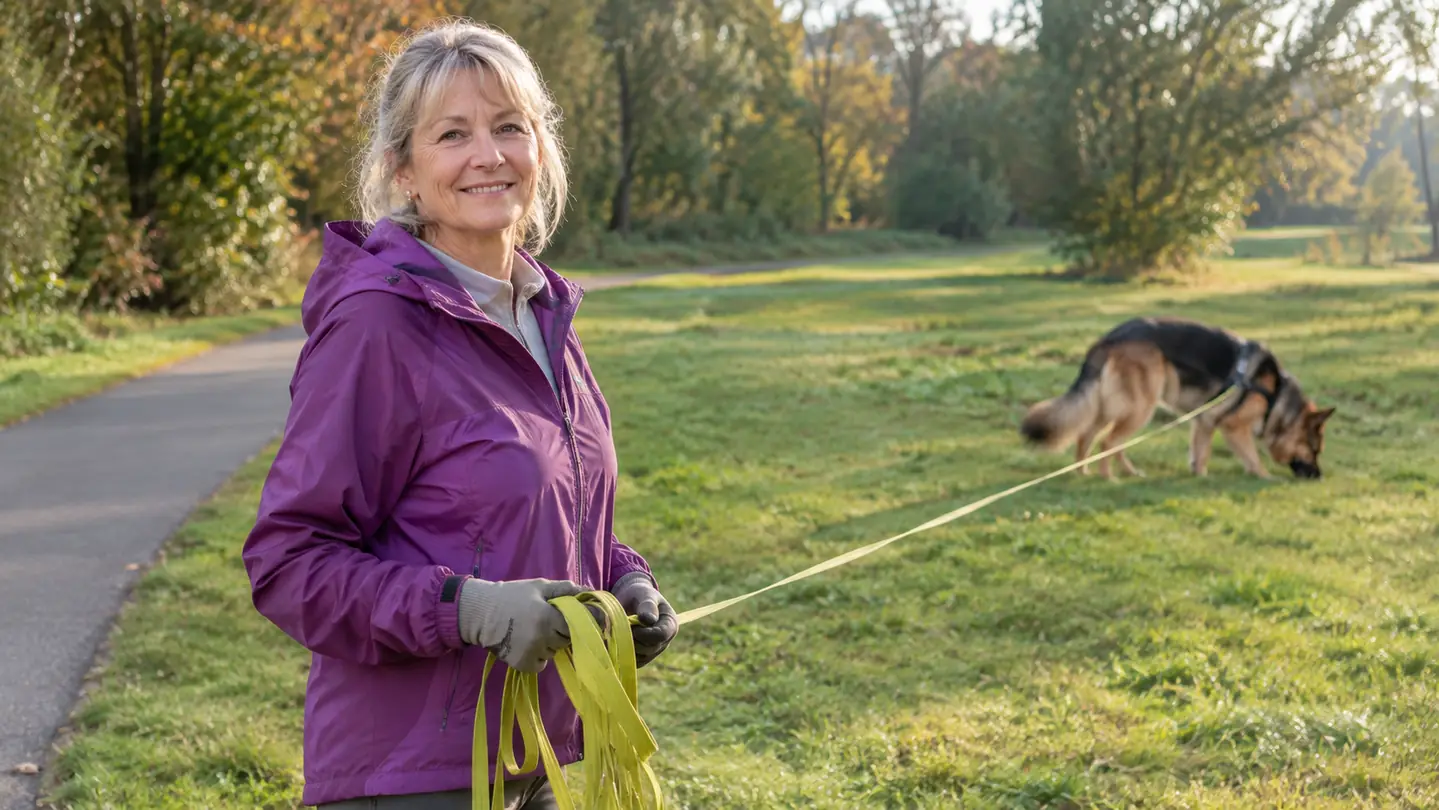
Nineteen months ago I stood in my own back yard with a retractable leash in one hand and a cup of coffee I never finished in the other, watching Biscuit hit the end of the cord at a dead run. The lock slipped under my thumb. The cord paid out another ten feet before he slowed down, and that was mostly because a smell interested him more than the fence line did. My palm was red for two days.
I bought a Hi Kiss long line that same week. Fifteen feet, three quarter inch nylon, swivel bolt snap. I have used it for recall practice for about eighteen months now, in my yard and in the open grass at the greenway, where the sight lines are long and there is not much to run into. I am not a trainer. I am a retired school bus driver in Knoxville with one dog, a four-year-old Lab mix, and a four-foot fence. Everything below happened in my own yard.
So here is the short answer, before the table. For teaching a dog to come when called, the long line is the safer tool by a wide margin. For a slow walk around the block with a dog that already walks politely, a retractable leash is fine, and I will not pretend otherwise. The trouble starts when a person buys one tool and expects it to do the other tool's job.
| Hi Kiss long line, 15 ft | Retractable leash | |
|---|---|---|
| Length | Fixed 15 feet, the same every session | Pays out and locks wherever your thumb lands |
| Recall practice | Dog learns one boundary, and a slack line means come back | The boundary moves every time the button is pressed |
| Everyday neighborhood walk | 15 feet of nylon to gather and carry | One hand, the housing takes up the slack |
| Wet weather | Wet nylon has to be coiled and stuffed in a pocket | Nothing to coil, the housing does it |
| If the dog bolts | Let the line run out, then step on it | Rests entirely on the lock holding |
| Tension on the collar | Line goes slack whenever the dog is near you | The spring keeps light tension even at rest |
| Hand comfort | Nylon burns bare skin, so I wear a glove | No line dragging across the palm |
| Best for | Recall work in open grass | A polite dog on a relaxed stroll |
That table is the summary. The rest of this is what those rows cost me in practice, because a row in a table does not tell you how it feels when your dog is forty feet away and your thumb is doing all the thinking.
Where the Long Line Wins
The Hi Kiss line is a fixed fifteen feet, and that fixed number is the whole point. Biscuit learned in about eight weeks in the yard that fifteen feet is where the line runs out. He also learned that when he hears his name at that distance and turns around, something good happens at my feet. Neither lesson survives a leash that changes length every time my thumb moves. A retractable gives the dog a different boundary on every single repetition, and a dog cannot learn a rule that keeps moving. I measured my yard, because I am that person. It is about twenty-two feet across at its widest, so fifteen feet of line leaves roughly seven feet of margin before the fence. That is enough room to turn around and not enough to build real speed, which turned out to be the right size for a beginner. Recall in that yard was reliable after about eight weeks. At the greenway it took about five months, because the greenway has squirrels.
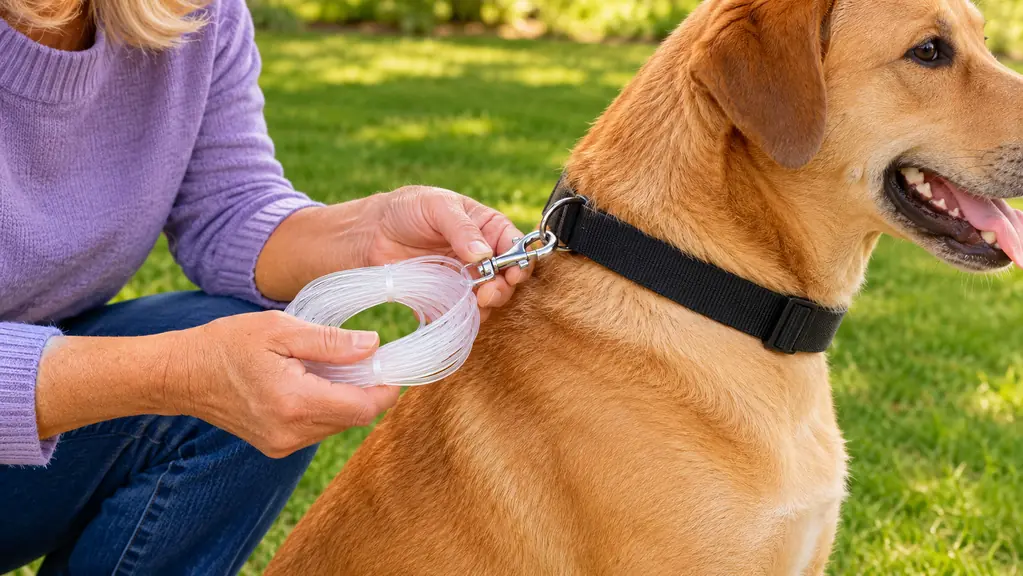
The second thing the long line does is teach with slack. When Biscuit is close to me, the line hangs in a low loop near the grass. When he drifts out, it straightens. That straight line is information he can feel through his collar, and I never have to open my mouth. The swivel snap on this line resists twisting, which matters more than it sounds like it should. A line that flips and tangles at the clip is a line that jerks the dog's collar for no reason at all. I clip it to the back ring of his plain flat collar, never to the chest ring of his harness.
The third thing is that a long line fails in a way I can manage. There is no lock to slip, no spring to give out, no button to find in a hurry. If Biscuit bolts, the line runs out and I step on it with the flat of my boot, or I brace and hold. The worst case is fifteen feet of nylon and a sore arm. I had one small taste of the other kind of failure, and one was enough.
Where the Retractable Leash Wins
I will say the obvious thing that long line people tend to skip. For a plain walk around the block, a retractable leash is more comfortable. One hand holds the housing, the dog sniffs a hedge, the cord goes out and comes back, and you never once bend over to gather wet nylon in the rain. Biscuit and I did that walk for a long time before the yard work started. If your dog walks on a loose leash and stops when you stop, the retractable does the job it was built for.
It also keeps your other hand free, which sounds small until you are carrying a bag and a set of keys at the same time. And the housing takes up the slack so you are not coiling a cold wet line against your coat sleeve in February. February is the honest test, as it happens. I remember one walk cold enough that I had my hood up, and Biscuit stopped to sniff the same mailbox he sniffs every single morning. I stood there with one hand in my coat pocket and waited, and it cost me nothing. With the long line, that same stop means I am holding a wet coil in the wind while he takes his time. I know which one I would rather do at seven in the morning in January.
The fifteen feet of nylon that finally made recall practice make sense
The Hi Kiss long line is a plain 15-foot nylon lead with a swivel bolt snap. No lock, no spring, nothing to slip under your thumb. I clip it to the back ring of Biscuit's flat collar, pull on a glove, and practice the same fifteen feet every morning. Today's price is on the listing.
Amazon Check Today's Price on Amazon →How I Tested Both, and What Went Wrong
The retractable failure was not dramatic, which is exactly what made it useful to me. I had Biscuit on the cord in the yard, he spotted the mail truck, and he went. My thumb found the button, the lock caught for about a second, then the cord kept coming. He got maybe ten extra feet before he reached the corner of the fence and stopped. Nobody was hurt. But I stood there with a red palm and a dog who had just learned that the end of the leash is negotiable.
The long line has no moment like that. It has boring moments instead. For the first month, half of every session was me standing still in the grass waiting for Biscuit to finish sniffing, with fifteen feet of nylon lying on the ground between us. If you have never done it, that is what recall practice looks like at the start. Not a dog sprinting back to you. A dog sniffing, and you waiting, and then one repetition where he lifts his head. For the first week I timed the sessions at twenty minutes and wrote down how many times he actually turned and came. Monday was two out of eleven. Friday was four out of eleven. That is the whole curve at the beginning, and it is why I tell people not to judge a long line by the first three days. The clicker did most of the work. Biscuit connected the click with the treat in about three short sessions, and after that the sound alone would turn his head.
I wear a leather work glove on my right hand now. Nylon at speed will burn you and I learned that the same week I bought the line. I also gather the slack in a loose loop rather than a tight coil, so it does not knot when he circles me twice before he settles. Small habits, learned the hard way, and both of them matter more than which brand of line you buy. Fifteen feet of nylon is not complicated. The handling is the part you have to learn.
The first time Biscuit came back to me from fifteen feet away, he did it for a piece of kibble and the sound of a clicker, not because I reeled him in.
The Part Nobody Tells You About Recall Training
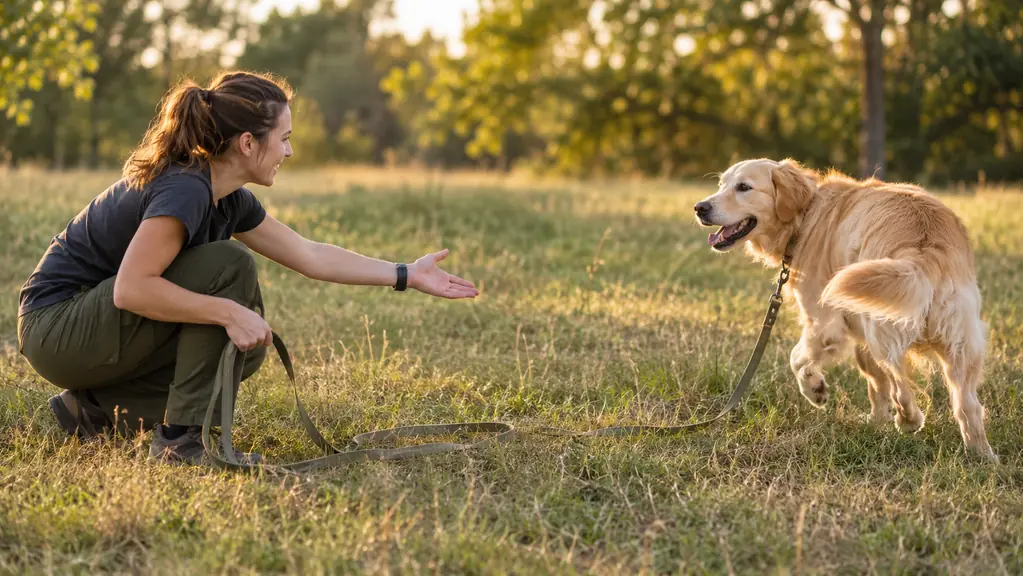
A long line is a boundary, not a brake. That distinction took me a while. In the beginning I used it like a fishing reel, pulling Biscuit back toward me hand over hand. All that taught him was that coming to me meant being dragged by the collar, and he got slower about it every week. The line is there so he cannot leave. It is not there to bring him in. What brings him in is the reward, which for us is a marker word and a piece of kibble from the pouch on my belt.
The other thing nobody tells you is that you should never let the dog hit the end at a run. Fifteen feet of nylon at a full sprint is a hard stop on the dog's neck, even on a flat collar, even with a dog this size. I call before he reaches the end. If he does hit it, the session ends on a quiet note and we go back to shorter distances the next day. That is not a rule I read in a book. It is a rule I made after I watched him cough once, and once was plenty. The day it happened the light was flat and the grass was wet and he was already at a trot when I called. By the time I got the word out he was at the end of the line. I walked him back toward the house and we quit for the morning. Nothing dramatic. But I started calling earlier after that, at maybe ten feet instead of fifteen, and the sessions got quieter and the recall got better, which surprised me then and does not surprise me now.
Two Things the Long Line Will Not Fix
It will not stop a dog from pulling. That was a separate problem and it needed a separate tool. For Biscuit, a front-clip harness did more in six weeks than any leash did in a year, and he still wears it on our twice-daily walks with an ordinary six-foot leash. The long line is for practice in open grass, not for the sidewalk. If your dog drags you down the street, a longer leash just gives him more room to build speed.
It will not replace judgment either. Fifteen feet of line in a crowded park is a nuisance and a hazard, and it is not a substitute for space. I use it in my yard and at the greenway on weekday mornings when the path is mostly empty. Biscuit has never been off line in an unfenced area and he is not going to be, because the day he spots a deer is the day I find out how good my recall really is. I would rather find that out with fifteen feet of nylon attached.
Who Should Buy Which
Buy the long line if you are teaching recall, if you have open grass or a quiet greenway to practice in, and if you are willing to wear a glove and stand still for twenty minutes at a stretch. Buy the Hi Kiss one specifically if you want a tool with nothing to break. Fifteen feet, three quarter inch nylon, a swivel bolt snap, and a snap closure that has not come loose on me once in eighteen months of twice-weekly use.
Buy the retractable if your dog already walks politely, if your walks are short and on sidewalks, and if you want a free hand. Do not buy either one hoping it will fix pulling, because pulling is its own problem with its own solution. And if you are not sure which camp you are in, buy a plain six-foot leash first. Most dogs need one of those long before they need anything longer, and the money you save can go into treats.
Start with fifteen feet and a pocket full of kibble
The Hi Kiss long line is the tool I still reach for every morning, eighteen months in. Clip it to the back ring of a flat collar, put a glove on, keep the slack gathered, and give the dog a reason to come back that has nothing to do with being pulled.
Amazon See the Hi Kiss Long Line on Amazon →