
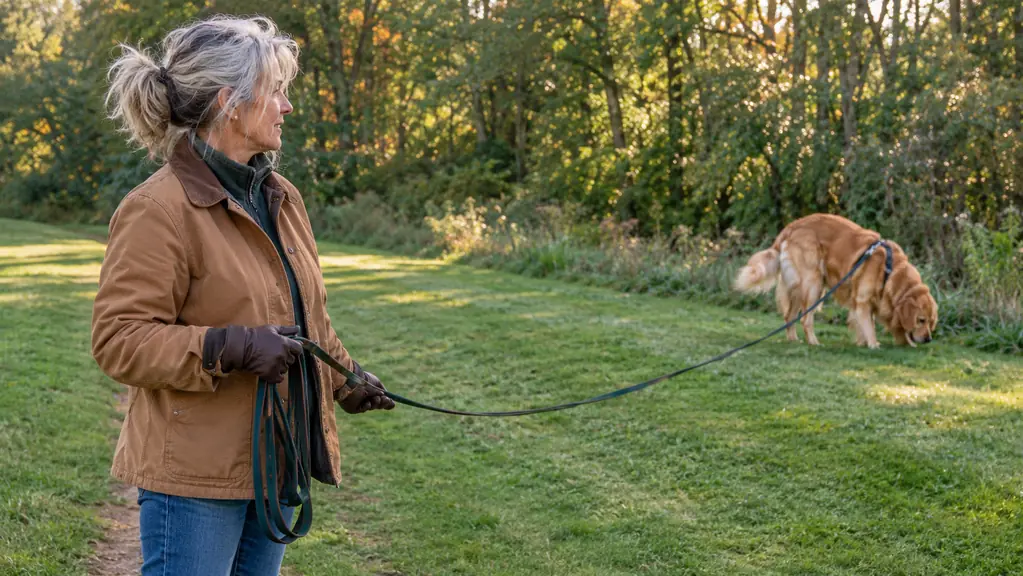
Biscuit came out of the shelter at fourteen months old already knowing how to pull. What he did not know was how to come when I called him, and for the first several months I told myself that was a training problem I could fix with more repetition in the back yard. It was not. The back yard was the only place he was reliable, and the reason was simple. It was the only place I trusted him enough to let him get any distance from me. The Hi Kiss long line is what broke that loop.
I am not a trainer. I am 58, retired after decades of driving a school bus, and I live in Knoxville with my husband Ray and one dog. I bought the 15 foot Hi Kiss training lead about 18 months ago, right after I finally admitted that a retractable leash was making the exact problem I was trying to solve. Dr. Sellers, our vet, is the one who suggested a long line before I ever went looking for one. What follows is what the line actually changed in my yard and on the greenway. This is not a method I invented. It is a list of what I noticed.
Fifteen feet of nylon is what turned calling into a real conversation
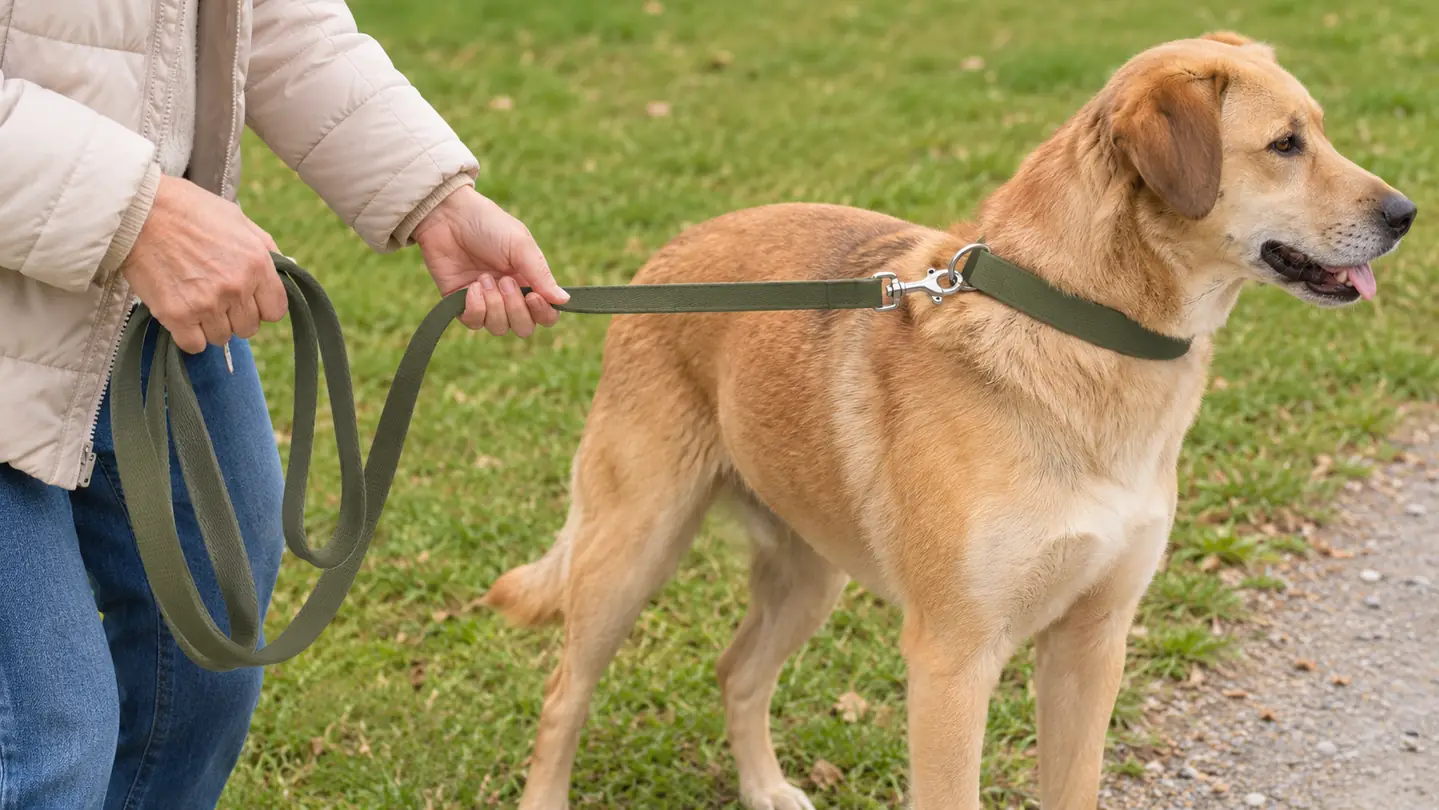
The same line has been on Biscuit for 18 months of yard work and greenway practice. Three quarters of an inch wide, 15 feet long, swivel bolt snap, clipped to the back ring of a plain flat collar.
Amazon Check the Hi Kiss long line on Amazon →Why a Long Line Works Better Than Repeating Yourself
Fifteen feet gives your dog an actual decision to make
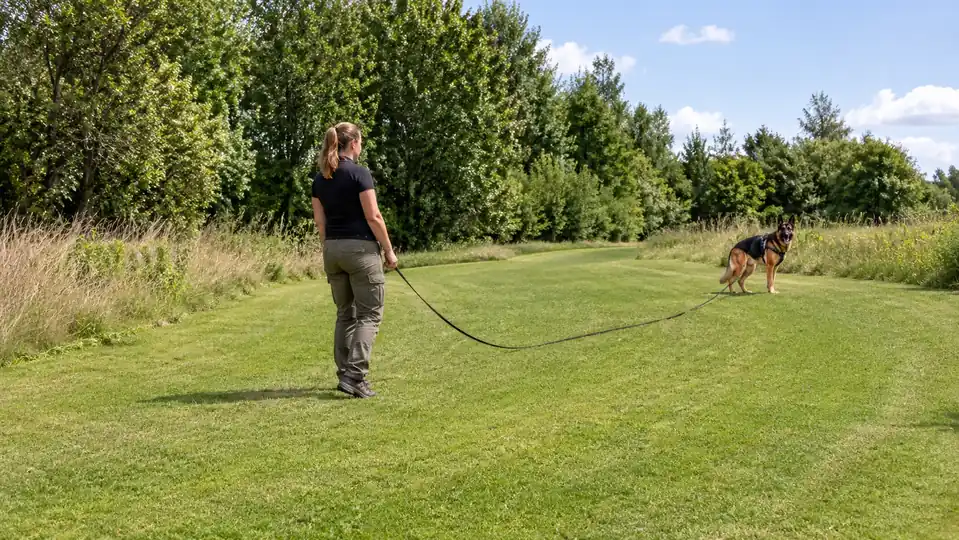
A six foot leash makes the decision for him. He is at your knee already, so coming is not a behavior, it is just the absence of anywhere else to be. At 15 feet, Biscuit had to turn, look, and travel back to me on his own four feet, which is the thing I wanted to reward. That distance is the entire reason I bought this line. It is long enough to create a real choice and short enough that I can still step on it when the choice goes sideways.
A blown recall stops being a disaster
The first time Biscuit ignored a call on the long line, he got about 15 feet away and then the line went slack in the grass. Nobody got hurt, no road was involved, and I walked over, collected him, and reset. On a loose dog, that same mistake ends the session and possibly the week. The line turns a failure into information, which is all a stubborn dog can give you some days. I stopped dreading the moment he would test me, because the test stopped being expensive.
The bolt snap swivels, so the line does not braid itself
Biscuit circles when he is excited, and a line without a swivel turns into a braid in about four seconds. The bolt snap on this one swivels, so the line falls back out instead of winding tighter with every lap. That sounds like a small detail until you are standing in wet grass untwisting 15 feet of nylon while your dog leans the other direction. The swivel is why we can practice turns and circles without me stopping every minute to straighten the hardware.
Three quarter inch nylon is thick enough to hold with a glove on
The line measures three quarters of an inch wide, and that matters more than I expected. A thinner cord cuts into a closed hand when a 62 pound dog hits the end of it. I wear a pair of cheap leather work gloves every single session, and with the wider nylon I can hold the line, feed it out, and take it back without it sawing at my fingers. If you have never handled a long line, start with gloves and a wider one. Your hands will thank you in week two.
Clipping to the back ring of a flat collar keeps the lesson clean
On neighborhood walks Biscuit wears the front clip harness and it steers him beautifully. I do not use it for recall practice. The front clip turns him sideways by design, and I want him free to turn and come straight at me. So the long line goes on the back ring of a plain flat collar and nothing else. It is the one piece of gear I refuse to mix jobs with. Walks are walks, recall practice is recall practice, and keeping those separate made both of them clearer.
Recall in the fenced yard came together in about eight weeks. The greenway took closer to five months, and the line is still on him.
The nylon shrugs off wet grass, gravel and dragging
Our Hi Kiss line has been dragged through wet grass, across gravel at the greenway, through a mud puddle Biscuit found in February, rained on, and left in the garage more than once. Nylon does not soak up water the way cotton does and it has not frayed at the snap. I rinse it and hang it over the porch rail maybe once a month. The listing says it outlasts cotton leashes. After 18 months of this, I have no reason to argue with that.
You can practice in public long before your dog is perfect
The greenway near our house is busy at seven in the morning and nearly empty at two in the afternoon. That empty hour is when we worked. Fifteen feet of line on a quiet path let me practice a recall in a place that had squirrels, bicycles and other dogs in it, without gambling on any of them. If he had slipped a collar there with no line attached, I do not want to think about it. Because the line was on him, I could find out how he behaved in public before I needed him to.
One line carries other skills besides recall
Recall is why I bought it, but it is not the only thing we have used it for. The listing mentions other obedience skills, and that turned out to be true in our house. We used the line to teach a stay at a distance, a wait at the edge of the yard, and a leave it on a moving squirrel. Distance is what makes those lessons real. At six feet, your dog is guessing what you want. At 15 feet, he has to decide for himself.
It shows you what your dog actually does at 15 feet
Here is the part nobody tells you. Practicing recall on a long line shows you what your dog does when he is 15 feet away, which is often not what you assumed from the back door. I thought Biscuit was ignoring me out of stubbornness. What I saw on the line was that he was working a scent trail and genuinely had not heard me. That changed how I trained. I stopped repeating the cue louder and started waiting for the moment he turned his head.
It gave me a timeline I could actually live with
Recall in our fenced back yard came together in about eight weeks of near daily short sessions. The greenway took closer to five months before I trusted him at the far end of the line. That is our timeline, not a promise, and your dog may be faster or slower. I still use the line every time we practice and I still do not let him off it in an unfenced area. Eighteen months in, the line is not a training phase anymore. It is just how we do this now.
What I'd Skip
I would skip the retractable leash, and I say that as somebody who used one for months. The locking mechanism teaches your dog that tension is normal and it gives you no clean way to reward a check in. I gave mine away before I bought this line and I have not missed it. I would also skip starting with a 30 foot or 50 foot version. Fifteen feet is already a lot of nylon to manage with two hands and a treat pouch, and longer only makes the tangle worse while you are learning. And I would skip going off line in any unfenced area, no matter how good the last session went. Biscuit is reliable in our yard and decent on the greenway, and he is still on the line every time we leave the house.
Fifteen feet, a flat collar, and a pair of gloves. That is the whole setup.
I am not promising your dog will be reliable in eight weeks. I am telling you that this line is the piece of gear that let me stop guessing and start practicing, in a yard and on a greenway, for 18 months and counting.
Amazon See the Hi Kiss long line on Amazon →