
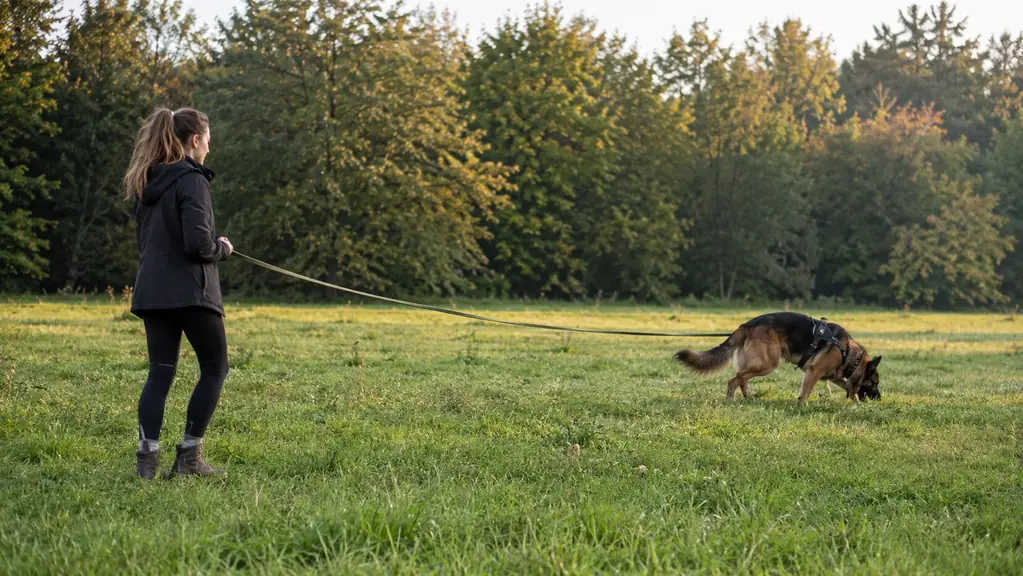
The first time I clipped a 15 foot line to Biscuit's collar, I thought I had wasted my money. He hit the end of it in about four seconds, the snap gave a small jerk, and there I was in the middle of the greenway holding a rope while a 62 pound Labrador mix stared back at me like I had ruined his whole afternoon. That was roughly eighteen months ago. I still use that same Hi Kiss long line four or five times a week and I would buy it again. But I want to tell you the parts most reviews leave out, because a long line has a personality, and some of that personality is annoying.
I am not a trainer. I am 58, retired from driving a school bus in Knoxville, and I live in a small one-story house with a fenced back yard with my husband, Ray. I adopted Biscuit from a shelter at 14 months. He pulled hard, jumped on guests, and barked at the mail truck. I learned reward-based training the slow way, mostly by getting things wrong first. So this is not a professional assessment. It is what happened in my yard and on the greenway.
The Quick Verdict
A plain, tough 15 foot nylon line with a swivel snap that does exactly one job well. Buy it for recall practice, not for walks, and budget for gloves.
Amazon Check Today's Price →If Recall Work Is On Your List And You Have Been Waiting For A Fence, Start Here
Fifteen feet of 3/4 inch nylon and one swivel bolt snap. Nothing to charge, adjust, or repair. It is the version I have used four or five times a week for eighteen months.
Amazon Check Today's Price on Amazon →What the Hi Kiss Long Line Actually Is
The listing says it plainly: 3/4 inch wide nylon, 15 feet long, a swivel style bolt snap, snap closure, and 1.76 ounces of weight. There are longer versions in the same listing, and I will say up front that I have only used the 15 foot one, so I am not going to pretend to review the rest. I picked 15 because I wanted distance for recall work without giving Biscuit enough rope to build real speed before he hit the end. On a 62 pound dog, a longer line means a harder stop at the end of it, and I did not want to find out how hard.
There is no bungee, no padding, no second handle to grab, and no reflective stitching that I can find. The Hi Kiss line is a length of nylon with a snap on one end. That sounds like a complaint. It is not. Everything on a long line that is not nylon is something that can snag, rot, or break, and this one has exactly one moving part, the swivel. I have owned enough gear with ten features and three failures to appreciate a product that only makes one promise.
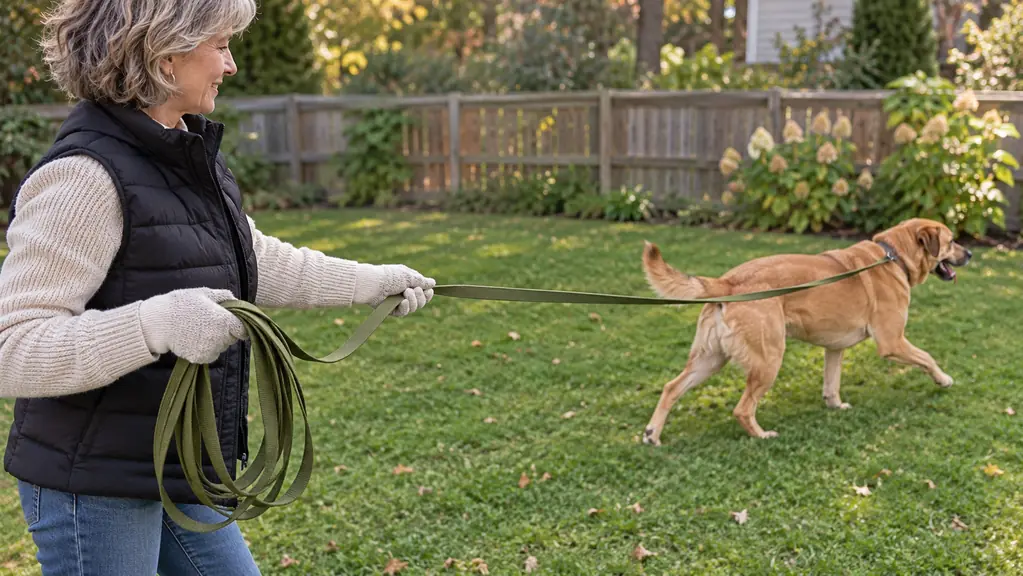
How I've Used It, and Where
I clip it to the back ring of a plain flat collar. Not the front ring of his Easy Walk harness, and I want to be clear about why. That harness works by turning him when he pulls, and a 15 foot line feeding through the chest ring puts load in a direction it was not built for. The back ring of a flat collar takes a straight pull. That is the setup I ran past Dr. Sellers before I ever used it, and it is the only setup I have used in eighteen months.
The greenway near my house has a long open stretch of grass off the main path, and that is where we do most of our work. I also use the line in my own back yard, but the fence is only 4 feet tall, so the yard is for short sessions and the greenway is for the real thing. I have never once let him off the line in an unfenced area. Not once. The line is the reason I can say that without hesitating.
I wear gloves. Every time. The first month I did not, and I got a burn across two fingers that took a week to stop stinging. That was not the dog's fault. He ran, the line ran through my hand, and nylon does what nylon does. A pair of leather work gloves fixed it completely. I keep a pair hanging by the back door so I do not have an excuse to skip them.
A typical session is about ten minutes. I call, he comes, I pay him with a piece of kibble or a sliver of cheese, and I send him off again with a release word. We do maybe fifteen of those and then we walk the path on the ordinary 6 foot leash like normal people. The long line goes back in the bag and that is the whole outing. It has never been more complicated than that, and on the days I tried to make it more complicated, he was the one who suffered for it.
The Part Nobody Mentions: The Line Does Not Train Anything
A long line is not a training method. It is a fence you can carry. If you clip it on and let the dog drag it around the yard, you have bought a very long leash and nothing changes. The work is you calling, the dog choosing to come, and the line being there so that choosing is the only option left. That is the entire mechanism. The line buys you the ability to not repeat yourself forty times while he learns that ignoring you is free.
This matters because the reviews I read before I bought mine made it sound like the equipment would do something. It will not. Biscuit's recall in the yard got reliable after about eight weeks of near daily short sessions, and it took about five months before I trusted him on the line at the greenway with real distractions around. Eight weeks and five months are the honest numbers. The line did not shorten either one. It just meant that when he blew me off at forty feet, he did not get to keep going.
The listing also says the nylon will outlast cotton leashes, and I cannot argue with that because I have not used a cotton long line. What I can tell you is that after eighteen months of dragging through grass, dew, mud, and one patch of something I chose not to investigate, the nylon on mine has no fray, no fuzz, and no soft spot. The stitching at the snap is the one place I look twice, and it looks the same as the day I took it out of the package.
The Annoyances, In Order of How Much They Bother Me
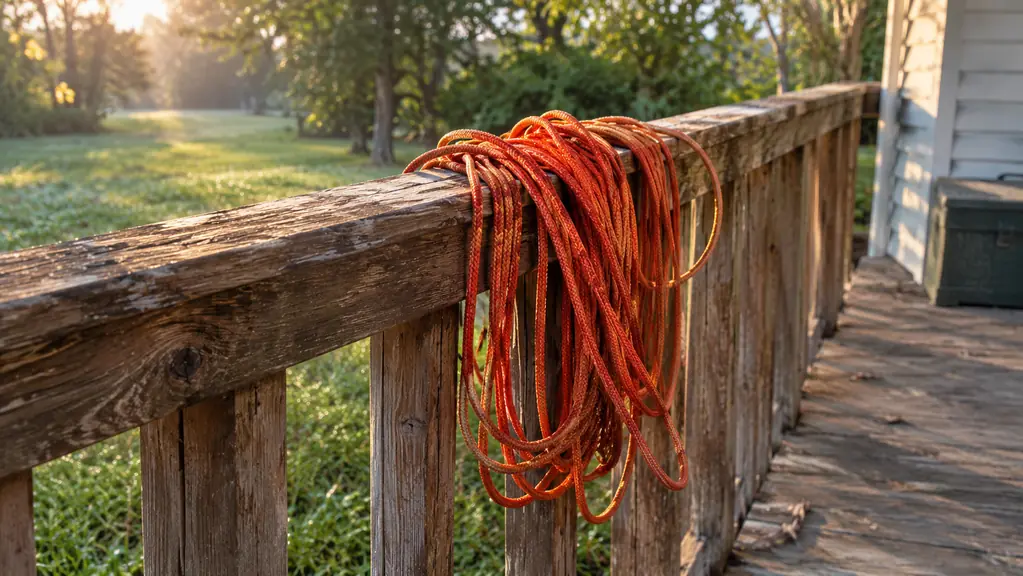
First, the line gets wet and stays wet. Nylon soaks up dew, mud, and greenway puddles, and a wet 15 foot line is heavier and slaps against your leg on the walk back to the car. I hang mine over the porch rail to dry. If I forget, it smells like the yard the next day. Nobody warned me about the smell, so consider this your warning.
Second, there is nothing to grab when you need to shorten it fast. When a bicyclist comes up behind us, I want six feet of line, not fifteen, and there is no second handle to choke up on. I gather the slack in loops over my free hand and pin it against my hip. It works, but it takes two hands and about three seconds, and three seconds is a long time when a Labrador mix has decided a squirrel matters more than I do.
Third, the snap. I have had no failure in eighteen months of steady use, and the swivel does keep the line from twisting itself into a cable. But it is a plain bolt snap, and I check it every single time before I clip it on. If it ever did open, Biscuit would be loose in an unfenced area, so checking is not optional in my house. I do not think the hardware is bad. I think it is the one part of the Hi Kiss line I would never take on faith.
Fourth, and this is the one that decides whether you like the product or resent it: you have one hand permanently occupied. Fifteen feet of line plus a dog means no coffee, no phone, no bag of anything. I carry treats in a pouch on my belt and that is the limit. On a hot morning I have to plan water around the fact that I cannot hold a bottle and the line at the same time, and I usually just drink before we leave and wait until we get home.
Fifth, neighbors. Most people who pass us on the greenway are kind about it, but every few weeks somebody tells me I should just let him run, or that their dog never needed a rope. I have stopped explaining. If you are the sort of person who minds being watched while you practice the same thing fifteen times in a row in the same patch of grass, this part of it will wear on you more than the nylon will.
What It Actually Changed About Biscuit's Recall
The change was not dramatic. It was cumulative. In the first weeks, Biscuit would get to the end of the line, feel the stop, turn around, and I would call him back and pay him. Over and over in the same patch of grass, until turning around when he heard his name stopped being a decision and started being a habit. The line let me practice that a hundred times a session without ever having to chase him, and without either of us getting frustrated.
The other thing it changed was my own nerves. Before the long line, I did not practice recall anywhere interesting, because I was afraid. Fear makes you call too loud, too often, and too late. With the line on, I could let him get twenty feet out and actually work the problem. A calmer handler is not a small part of this, and I did not understand that until I stopped being scared of my own yard.
I should also say what the line does not fix. Biscuit still pulls on the walk to the greenway. That is the harness's job and it does it. The long line is not a walking leash. I made that mistake once, on a neighborhood sidewalk, and spent ten minutes winding nylon around my own wrist while a neighbor waited for us to move. Do not use it on a sidewalk. Do not use it on a busy path. Use it where there is room and where you can see what is coming.
There was one afternoon last March that I still think about. An off-leash dog came around the bend and Biscuit went up on his toes, weight forward, and I could feel the decision forming in him. I stepped on the line, knelt on the grass, and we waited it out while the other owner collected their dog. Nobody got hurt. I am not sure what that afternoon looks like without fifteen feet of nylon between me and my dog, and I would rather not guess.
What I Liked
- 15 feet of 3/4 inch nylon that has not frayed, stretched, or lost its shape in eighteen months of steady use
- The swivel bolt snap keeps the line from twisting up into a cable
- At 1.76 ounces, Biscuit barely notices it dragging behind him on the grass
- Nothing to adjust, charge, or repair, so it is always ready when we walk out the door
- It lets me practice recall at real distance without ever letting go of the dog
Where It Falls Short
- Nothing to grab close to the dog, so shortening up takes both hands and a few seconds
- Wet nylon gets heavy and holds a smell until it dries
- No padding at all, so gloves are not optional with a dog that runs
- Not a walking leash and not a substitute for training
- Fifteen feet is a lot of line to manage in a small yard
Eight weeks in the yard and five months on the greenway. The line did not shorten either number. It just meant that when he blew me off at forty feet, he did not get to keep going.
What I'd Do Differently
I would have bought gloves the same day I bought the line. I would have started in the yard instead of the greenway, because a 4 foot fence and a short distance teach the same lesson with fewer moving parts. And I would have picked one word and stuck with it. I bounced between two different recall words for a month, and it set us back a month, because Biscuit is not a linguist and I was handing him two names for the same job.
I also would have measured the line before I used it. Fifteen feet sounds short until you are standing in it. I paced a tape out in the yard and marked a spot on the fence, and that is how I learned my whole back yard is only about eighteen feet deep. Most of our long line work happens at the greenway because of that, not because the yard is bad, and I would have saved myself two confusing weeks by knowing the number sooner.
Who This Is For
If you have a dog who knows his name in the kitchen and forgets it outdoors, and you want to practice recall without a fence, this is the tool. It is also for the owner who has been putting off recall work because every method they read assumes an open field and a lot of confidence. Fifteen feet of nylon, a pair of gloves, and ten minutes in a yard is enough to start. That is genuinely all we did, and the Hi Kiss line is the only piece of gear that made those ten minutes possible.
Who Should Skip It
Skip it if you want a walking leash, because it is not one and it will not pretend to be. Skip it if your dog is a hard puller who has never had a day of training, because fifteen feet of line in the hands of a dog who has not learned to yield to pressure is a rope burn looking for a hand. Skip it if you have nowhere open to use it, since a long line in a narrow yard is mostly an exercise in untangling. And skip it if you will not wear gloves, because you will get hurt and you will blame the product.
Biscuit is four now, and the recall we built on the end of that line is the most useful thing he knows. Not because of the line. Because of the hundred small repetitions the line made possible. It is a plain object that does one job, and after eighteen months I still keep it by the back door next to the gloves.
Fifteen Feet Of Nylon, One Snap, A Hundred Chances To Get It Right
If recall practice is on your list and you have been waiting on a fence that is not coming, this is the version I have used four or five times a week since Biscuit was two.
Amazon Check Today's Price on Amazon →