
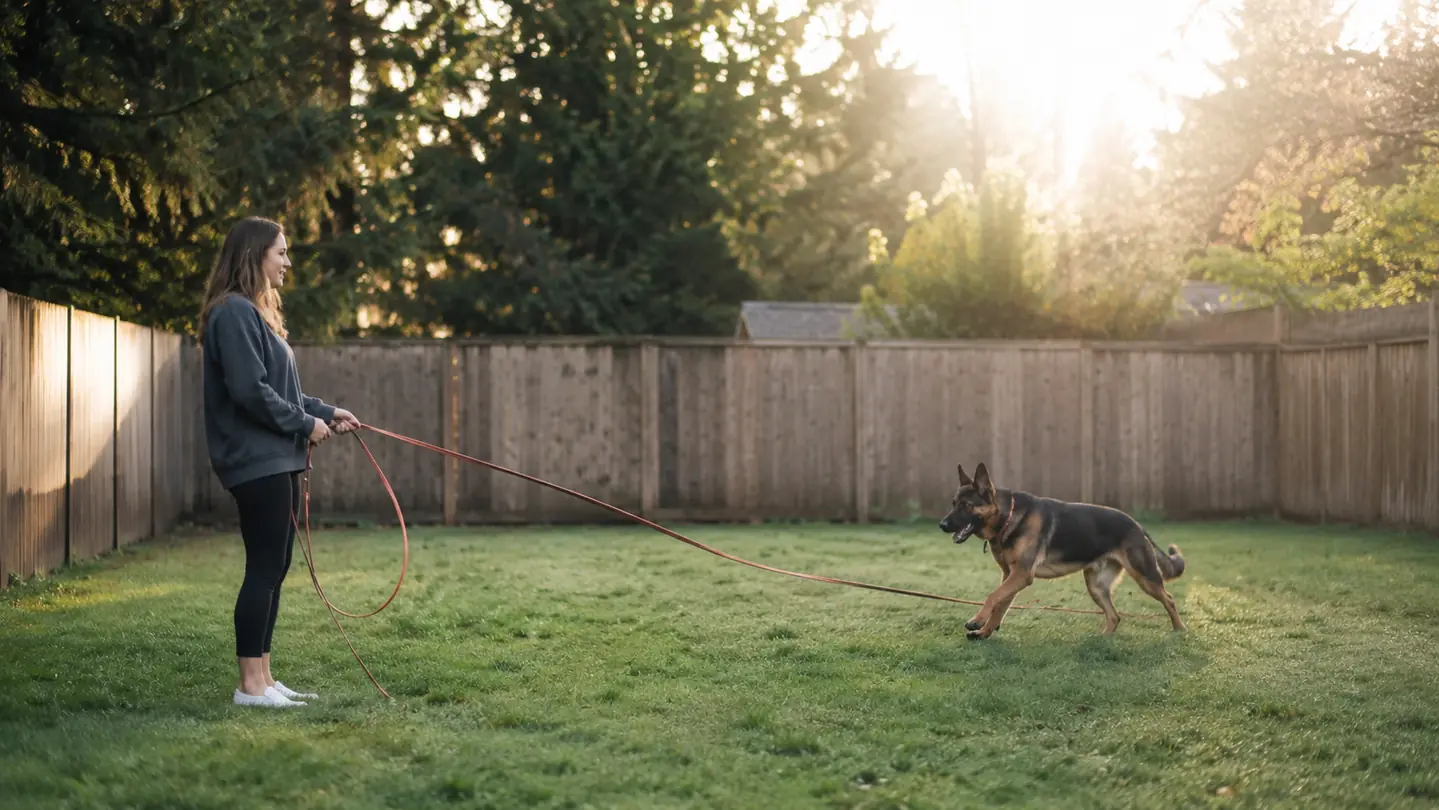
The first time I tried to teach Biscuit to come when called, I did what a lot of people do. I stood in my back yard, said his name in a cheerful voice, and watched him pretend he had never heard the word in his life. Biscuit is a 4-year-old male Labrador mix, 62 pounds, and I adopted him from a shelter at 14 months. He is a good dog. He is also the reason I bought a 15-foot Hi Kiss long line about 18 months ago and stopped pretending a retractable leash would solve the problem.
Recall is not a trick you teach once. It is a habit you build in small spaces, then test in bigger ones. The long line is what makes that testing safe. Mine is the Hi Kiss 15-foot, 3/4-inch nylon line with a swivel bolt snap. I use it only for recall practice, at the greenway and in open grass. I snap it to the back ring of a plain flat collar, never to the front ring of his walking harness. That one rule has kept both of us out of trouble.
The tool that lets you practice recall without gambling on a loose dog
A 15-foot Hi Kiss long line gives Biscuit room to make a choice and gives me a way to keep him safe while he learns. It is the line I have used for 18 months of recall work.
Amazon See the Hi Kiss Long Line on Amazon →Step 1: Teach the word in the house, where nothing is more interesting than you
Before the long line comes out, the word needs meaning. I started in my kitchen with Biscuit four feet away and a handful of small treats. I said 'Biscuit, come' one time, then walked backward two steps. When he followed, I marked it with a click and paid him. The clicker I use is a simple one I have owned for about 20 months. It took three short sessions before he connected the click with the treat.
The mistake I made early was repeating the word. 'Come. Come. Biscuit, come here.' All that teaches a dog is that the word is background noise. Say it once. If he does not move, make yourself worth moving toward: crouch, clap, turn and walk away. Then reward the moment he turns. I keep rewards in an eBasics treat pouch on my belt so I am not digging in a coat pocket with one hand while the other hand holds a line.
I did three to five repetitions at a time, several times a day, and quit while he was still interested. In the house, Biscuit was reliable within a couple of weeks. That did not mean he was reliable outside. It meant the word had a beginning.
Step 2: Introduce the long line in a low-distraction space
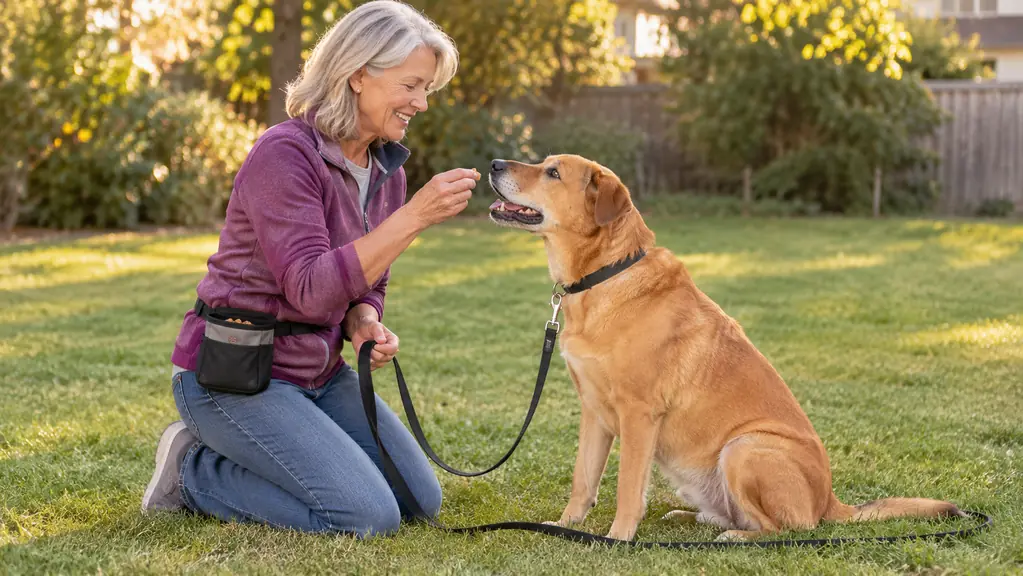
The first time I snapped the Hi Kiss long line onto Biscuit's collar, we went into my fenced back yard, not the greenway. The fence is 4 feet tall. It is not a training tool, but it is a backstop. I wanted the long line to be ordinary before I asked for anything hard. I let him drag it for five minutes while I followed, stepping on it now and then by accident, so the weight and the sound were not a surprise.
Then I put on gloves. Nylon can burn your hands when a dog hits the end of a 15-foot line, and I learned that the hard way with a previous leash. I held the line with both hands, let it slide, and did not wrap it around my wrist. I called him once, from about 10 feet away. When he came, I clicked and gave him a treat from the pouch. When he did not come, I did not yank. I stood still, waited two seconds, then made myself more interesting or walked away. The line was there to keep him from leaving the yard, not to correct him.
We did this for three days, ten minutes at a time. I used the same word, the same tone, and the same kind of treat. The Hi Kiss line is 15 feet, so I could practice at a distance that mattered without giving him the whole neighborhood. That is the point of the tool. It buys you a middle ground between a 6-foot leash and an off-leash dog.
Step 3: Add distance and proof, one foot at a time
Once Biscuit was coming in the yard at 10 feet, I started sending him away before I called. I would toss a treat a few feet past him, let him find it, then call once. The first few times he had his nose down and did not respond. I waited. Waiting is hard. Most of us fill the silence by repeating the cue, and that is how a dog learns that 'come' means 'keep sniffing until she says it louder.'
I built distance slowly. Ten feet, then 12, then the full 15. I practiced when he was hungry, before meals, and I used real food, not dry biscuits. I also practiced the recall after easy things, not only after hard things. If every call means the fun stops, a smart dog starts doing math. Sometimes I called him, rewarded him, and released him back to sniff. That kept the word from meaning 'the end of your freedom.'
By about eight weeks, his recall in my yard was reliable. I want to be clear about what that means. It meant he came most of the time in a place he knew, with a line on, when I had food. It did not mean he was ready for an unfenced field. I kept the long line on because a dog who is right 90 percent of the time is still wrong one out of ten, and one out of ten is enough to lose a dog.
The long line is not a leash you use because your dog failed. It is the tool that lets your dog practice being right.
Step 4: Practice at the greenway with real distractions
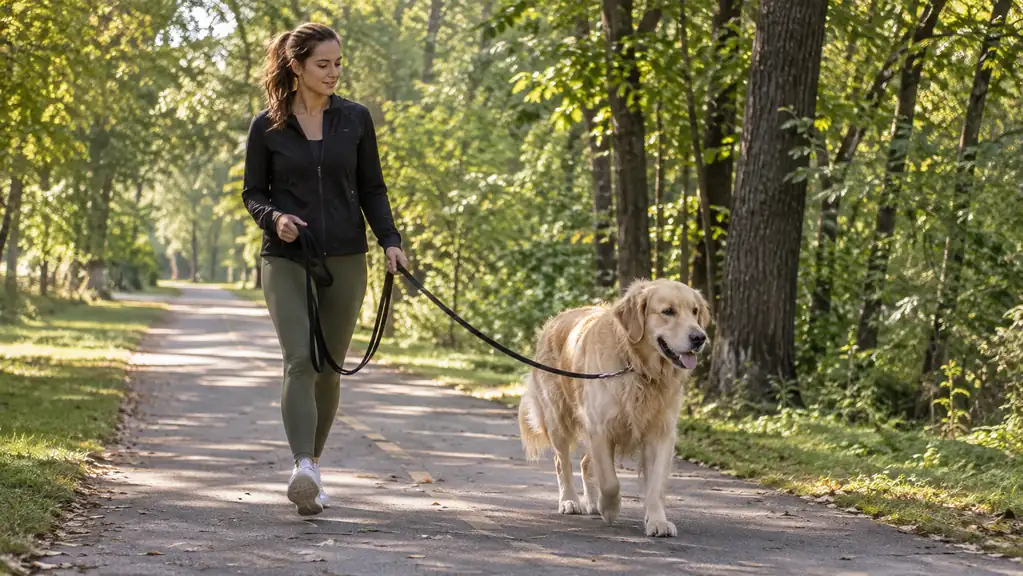
At about the three-month mark, I started taking the Hi Kiss line to the greenway near my house. This was a bigger test: other walkers, squirrels, bicycles, and smells that made Biscuit's ears turn off. I walked him on the line and a flat collar, and I kept my gloves on. I did not practice near the parking lot at first. We started on a quiet stretch of grass, maybe 30 feet from the path, and I kept the sessions short.
I looked for moments when he was already likely to check in. When he lifted his head from a smell, I called once. If he came, he got a jackpot: three small pieces of chicken, one after another, delivered close to my feet. If he did not come, I did not repeat the word. I waited, then stepped backward or turned and walked a few steps away. The line stayed slack unless he was about to hit the end. A tight line tells a dog he is being reeled in, and I wanted him to choose the turn.
It took about five months before I trusted his recall at the greenway in the situations we practiced. He still wears the line there. I have met people who can call their dog off a deer with no line. I am not one of them, and Biscuit is not that dog. The honest version is that the long line let us practice around real distractions without me holding my breath. That is worth more to me than a perfect story.
Step 5: Fade the line slowly and keep the rules
I have not faded the line completely, and I may not. In my fenced yard, Biscuit works off the line in our fenced yard now. In open grass or at the greenway, I keep hold of the Hi Kiss line. I never let him off line in an unfenced area. That is not a lack of faith in him. It is the same rule I would follow with any dog who has a nose and a pulse.
If you do want to fade the line, do it in steps. Go from holding the line to letting it drag. Go from dragging it to a shorter line. Go from a quiet place to a slightly busier one, and only move on when the last step is boring. Keep paying for the behavior. A recall that stops getting rewarded stops being reliable, and that is true for dogs who have done it a thousand times.
The other rule is that the recall word is never used for something unpleasant. I do not call Biscuit to clip his nails, put him in the car for a vet visit, or end a walk he is enjoying unless I have already paid him first. If 'come' means 'something bad is about to happen,' a dog will start taking his time. My husband Ray is better at this than I am. He calls Biscuit, pays him, then does the boring thing. It sounds small. It is not.
What Else Helps
The long line is the main tool, but it is not the only thing that helped. A treat pouch made a difference because I could pay Biscuit in under a second. The eBasics pouch I have used for about 22 months has a magnetic opening and holds enough treats for a 20-minute session. Before that I used coat pockets, and I ruined two coats with crumbs. The pouch is not fancy. It just keeps the reward where my hand expects it.
A clicker helped me teach new behaviors, but for recall I mostly used a verbal marker, the word 'yes,' because I do not want to be hunting for a clicker when Biscuit is 15 feet away. I still use the clicker for things like hand targets and settling on a mat. The two markers do not confuse him. One predicts a treat, the other predicts a treat. The bigger issue is timing, and that improves with practice.
The Easy Walk harness is for walks, not for recall practice. I snap the long line to the back ring of Biscuit's flat collar. The harness front ring is for pulling, and a long line on a front ring would be a mess. I also keep a KONG in the freezer for alone time, but that has nothing to do with recall. It is just part of our week. If you are working on recall, keep the tools separate in your head. The long line is for recall. The harness is for walks. The clicker is for new skills. The pouch is for carrying rewards.
Practice recall with room to move, not room to worry
The Hi Kiss long line gives you 15 feet of nylon and a swivel bolt snap, so you can reward the turn instead of chasing the mistake. It is the same line I have used for 18 months with Biscuit.
Amazon See the Hi Kiss Long Line on Amazon →