

Two winters ago my coat pocket smelled like a deli. There were crumbs of freeze-dried liver ground into the seam, a grease spot on the lining, and one morning a piece of hot dog I had forgotten about for a week. That coat went in the donation bin. The next one lasted about four months before it happened again, because I kept digging in it for a reward while a 62-pound Lab mix named Biscuit pulled me toward somebody's hedge. The eBasics treat pouch is what finally replaced my pockets, and I have now worn it for 22 months.
I am not a trainer. I am 58, I drove a school bus for a living before I retired, and I live in Knoxville with my husband Ray and one dog. I bought this pouch with my own money. So this is the version of the review I would give a neighbor over the fence: what it fixed, what it did not fix, and the couple of things that still irritate me after almost two years of wearing it twice a day.
The Quick Verdict
A 4.9-ounce bag with a magnetic lid that closes itself, room for up to 3 cups of rewards, and a belt that adjusts to roughly 50 inches. It ended the crumbs-in-the-coat problem for me. It does not hold a phone, and it will not teach your dog anything on its own.
Amazon Check Today's Price →The fix I should have bought before the second coat died
Magnetic opening, 900 denier polyester, 5 inches wide by 5.5 high by 3 deep when open, belt included and adjustable out to about 50 inches. I have worn mine on two walks a day for 22 months.
Amazon Check Today's Price on Amazon →How I've Used It
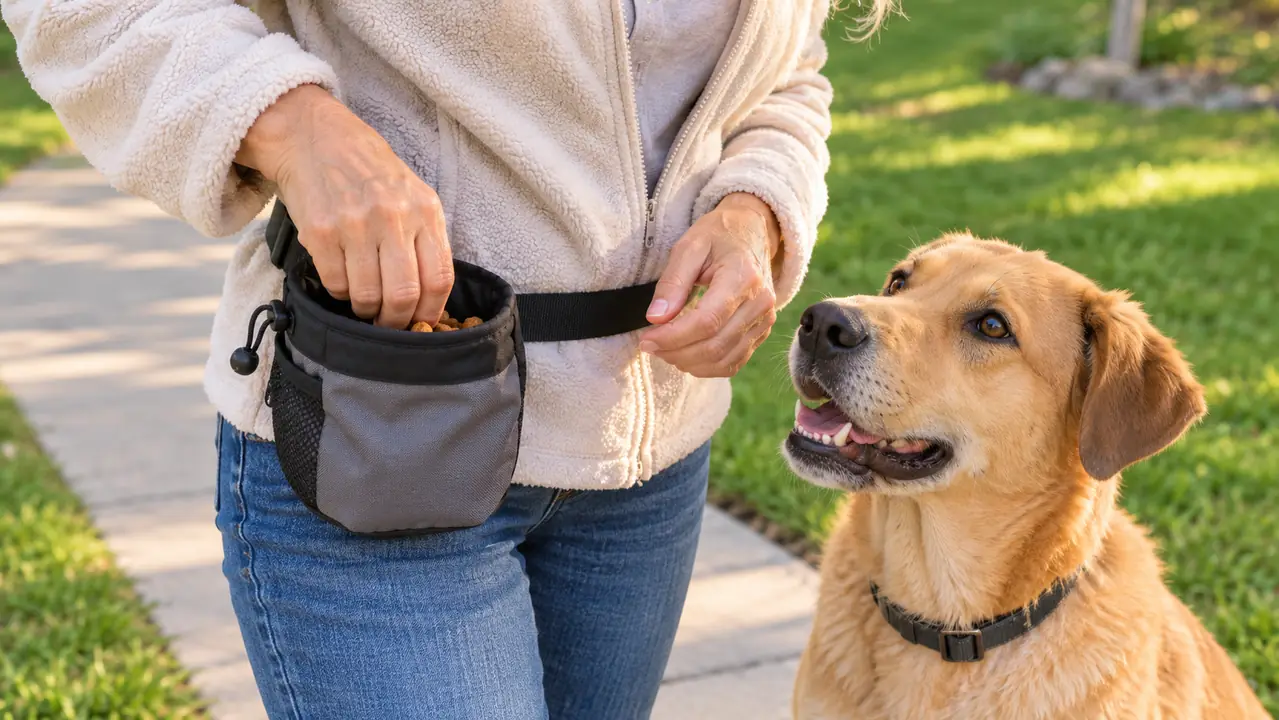
The pouch lives on my belt on the left side, because I am right handed and I want the reach to be short. It goes on before the leash does, morning and after supper, and in between it hangs on a hook by the back door. I wear the belt rather than clipping it. The belt comes with the pouch and adjusts out to roughly 50 inches, which is plenty for me over a pair of jeans. Two walks a day for 22 months is a lot of on and off, and the buckle has not slipped or stretched.
A typical morning is the same loop around the neighborhood, about 30 minutes, with Biscuit in his Easy Walk harness and an ordinary 6-foot leash. Halfway around there is a stretch where the sidewalk passes a row of garbage cans, and that is where the pouch earns its keep. I can get a piece of chicken into his mouth while he is still standing instead of hauling him forward and scolding him, which is what I used to do with my hand stuck in a coat pocket. The lid closes on its own when I pull my hand out, so I am not fiddling with a zipper while he leans into the leash.
I also use it in the back yard, which I did not expect. Most of the clicker work I do with Biscuit happens on the grass, six or eight minutes at a time, and the pouch comes with me. The blue clicker from a two-pack rides on my wrist, the pouch sits on my hip, and I do not have to set anything down or hunt for a treat between reps. That matters more than it sounds. When the reward is already at hand, you actually reward, instead of meaning to and then not bothering.
What Nobody Tells You About a Magnetic Lid
The opening is the whole idea, so here is exactly how it behaves. I push two fingers in, the lid folds back, I take a treat, and the lid drops shut behind my hand without me touching it. One motion. No zipper, no drawstring, no flap to tuck. If you have ever tried to unzip a pouch while a dog is bouncing at the end of a leash, you know why that is the feature and not a gimmick.
What nobody tells you is that a magnetic lid is not a seal. It keeps crumbs in during a normal walk, and it stays shut in the laundry basket and on the car seat. But if the pouch tips over, or if you set it down on its side on the driveway, treats come out. I learned that in a parking lot at the greenway. The eBasics lid is a lid that closes itself, not a lid that locks. Treat it like a bag you carry, not a container you can throw in a tote.
The listed capacity is up to 3 cups, with the bag measuring 5 inches wide, 5.5 inches high and 3 inches deep when open. I have never once filled it that far. A third of the way full covers a 30-minute walk with rewards to spare, and a full bag is more than I use across two walks plus a yard session. The 3-cup figure is a ceiling to stay under, not a target, because a bag stuffed to the top is the one time the lid will not sit flat.
The Belt, the Clip, and the 50-Inch Number
The belt is the part people ask me about, because a lot of pouches assume you already own one. The eBasics belt comes with it, adjustable, out to about 50 inches of total length. I threaded it once and have not thought about it since. It sits flat over jeans or work pants and does not ride up when I bend over to pick up after him.
There is a clip as an alternative, and I have used it on sweatpants and on the waistband of yard clothes. It works, but it swings. A pouch that swings ends up behind your hip where your hand does not naturally go, and then you stop using it. For me the belt is steadier, and the belt is what I would buy it for.
The one honest caveat is size math in winter. Fifty inches is generous on a 5-foot-6 woman in jeans and noticeably less generous over a heavy coat and a sweater. I wear mine outside the coat and it fits fine. If your waist plus winter layers runs large, take a tape measure to yourself before you assume anything. That is not a fault of the pouch, it is just the number you need to know.
What I Underestimated
What I underestimated was speed. A reward has to land within a second or two of the behavior or the dog has no idea what he did. With my hand in a coat pocket, that gap was closer to four or five seconds, especially with gloves on. With the pouch on my hip, the gap is about one second. Same dog, same treats, same owner, and the training finally started to stick.
The second thing I underestimated was how much of my training happened away from the sidewalk. I bought this thinking about walks and ended up using it mostly on the grass, in short sessions where I teach one new thing at a time and then stop. The pouch is the reason those sessions are easy to start. When the equipment is already on you, you train. When it is in a drawer, you mean to train.
On what goes in it: I use small pieces, cooked chicken cut to the size of a pea, or broken-up kibble that is a step above his dinner. Big biscuits do not work, because they take too long to eat and the walk turns into a chewing contest. The 900 denier polyester wipes out with a damp cloth, and I rinse it in the sink and turn it inside out to dry when I have had wet food in it.
What I Tried Before This
Before the pouch I tried a small plastic food container with a snap lid. It held treats perfectly and I never once used it, because it took two hands to open and both of mine were busy. I tried a zip-top bag in my jacket, which turned into the crumb situation and one memorable spill across the driveway. I tried a paper bag in my back pocket for about a week, and it dissolved.
The pattern was the same every time: the container was fine, the access was the problem. What I needed was a reward I could reach with one hand while the other hand held a leash. That is the whole test, and it is the reason a plain pouch on a belt beat a better container in a pocket. It is also why I would tell you not to overthink this purchase. The pouch does one job and it needs to do it in one motion.
Where This Pouch Falls Short
No phone. No keys unless you want a bulge against your hip. This is a bag for treats, and the people who complain that it will not hold a phone are asking it to be a fanny pack. I carry mine in my hand or leave it home. If you want one bag for phone, keys and rewards, this is not it, and I would rather say that plainly than have you find out a mile from the house.
The material holds a smell if you leave wet food in it overnight. That is true of every soft bag I have owned, and the fix is 30 seconds at the kitchen sink. What I would tell you is to empty it at the end of the day rather than leave a piece of hot dog in there until the next morning, which I did exactly once and regretted.
Two small irritations after 22 months. The first is that the belt buckle takes two hands to line up the first few times you wear it, which is annoying when the dog is already spinning at the door. The second is that if you overfill it past the 3-cup mark, the lid will not sit flat and treats sneak out when you lean forward. Neither one is a reason to skip it. Both are reasons to load it sensibly.
The pouch did not train my dog. It made me fast enough to reward him before he forgot what he had done.
What I Liked
- Magnetic lid closes itself, so the whole exchange takes one hand and about a second
- Belt is included and adjusts out to roughly 50 inches of total length
- Holds up to 3 cups, which is more than enough for two walks plus a yard session
- 5 inches wide, 5.5 high, 3 deep when open, so it sits flat against the hip
- 900 denier polyester wipes clean with a damp cloth
- Weighs 4.9 ounces, light enough that I forget I have it on
- Clip option works on sweatpants and yard clothes
Where It Falls Short
- No room for a phone or keys, it is treats only
- The magnetic lid is not a seal, so it spills if it tips over
- Overfill it and the lid will not sit flat
- Belt buckle takes two hands to align at first
- Soft fabric will hold an odor if wet treats stay in it overnight
What 22 Months of Wear Actually Looks Like
The pouch has been rained on, dropped in the yard, wiped down more times than I can count, and left hanging by the back door for almost two years. The polyester has not torn at the seams where the belt attaches, which is where a soft bag usually goes first. The lid still closes itself. I have not had to repair anything and I have not gone looking for a replacement.
What has changed is the smell on the days I forget to empty it, and a slight softness in the fabric from repeated washing. It does not look new. It looks like a thing that gets used twice a day, which is what I wanted from it. If you need a pouch that stays crisp and boxy, no fabric bag is going to give you that.
Would I buy it again? Yes, and I would buy it earlier, before the first coat was ruined. The 4.7-star average across 4,476 ratings is close to what I would give it, and my complaints are the ordinary ones from someone who has actually carried the thing: no phone, not a seal, do not stuff it.
Who This Is For
This is for the owner who is already paying for behavior with food and needs the payment to be faster. Walks, puppy classes, short yard sessions, polite greetings at the front door, all of it gets easier when the reward is on your hip instead of in a kitchen drawer. It is also for the owner whose coat has already been sacrificed, because you are the person who will actually wear it. That was me, and the eBasics pouch has outlasted two of my jackets.
It suits a dog like Biscuit too, meaning a dog who is food motivated and strong enough to make a two-handed treat fumble feel expensive. I am 58 with ordinary hands and ordinary patience, and I can work the lid without looking down at it. That is the entire pitch, honestly. Nothing about it is clever. It is just the right shape in the right place.
Who Should Skip It
Skip it if you want one bag to carry everything. This holds treats, and that is the design, not an oversight. Skip it if you train with a large volume of food for long sessions or for a dog who eats his rewards by the handful, because you will spend the whole time refilling a 3-cup bag.
Skip it if you genuinely will not wear a belt. The clip works, but a swinging pouch ends up behind you and then it stays in the truck. And skip it if your dog is the type to shove his nose into anything at hip height. The lid closes itself, but it does not lock, and a determined dog will figure that out faster than you would like.
Twenty-two months in, this is still the bag on my hip every morning
Magnetic opening that shuts on its own, up to 3 cups of room, 900 denier polyester, and a belt that goes out to about 50 inches. If your coat pockets look like mine used to, start here.
Amazon Check Today's Price on Amazon →