
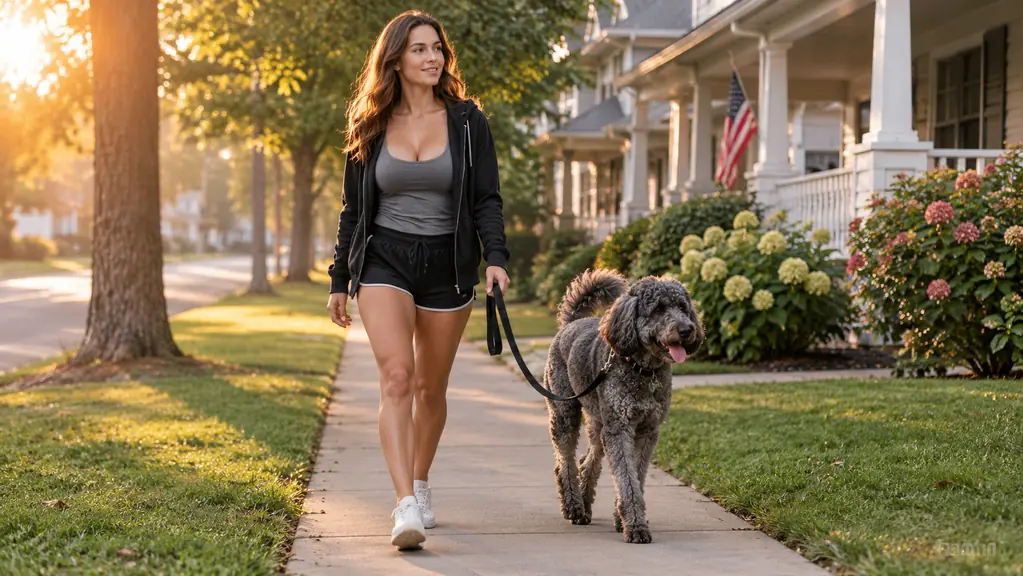
The first month with Biscuit, I walked him the way I had walked every dog since I was a girl: leash on the collar, arm braced straight, and a running apology to the neighbors. He is a 62-pound Labrador mix, adopted at 14 months, and he treated the sidewalk like a starting gate. My right shoulder ached by Thursday. There was a red crease across my palm. And every time a squirrel broke cover at the greenway, I went with it.
A back-clip harness made that worse. When the leash attaches behind the shoulders, a dog can lean his whole weight into it and pull like a sled dog, and that is exactly what Biscuit did for most of a year. A front-clip harness changes the geometry. The PetSafe Easy Walk clips at the chest, and when he pushed forward the strap drew him sideways instead of letting him dig in. That is the whole mechanism. It does not teach him anything by itself, and I would not trust anybody who says a harness alone fixes a puller. What it does is give you enough control to start teaching.
The harness that gave me back my right shoulder
PetSafe Easy Walk, front chest clip, martingale loop, sized for dogs from 50 to 100 pounds. Two years of twice-daily walks, one hand wash a month, and a dog who now walks beside me instead of towing me.
Amazon Check Today's Price on Amazon →Five Steps, in the Order That Worked
Step 1: Measure Him and Fit It Before You Blame the Harness
The first Easy Walk sat in its box for four days because I was certain I had ordered wrong. I finally put a cloth tape around Biscuit's girth, right behind his front legs, and got 31 inches. The Large is made for dogs from 50 to 100 pounds and he was 62 at the time, so the size was right and I had simply been avoiding the work of fitting it.
The straps are the part people skip. The harness has quick-snap shoulder straps and a buckle closure, and the belly strap is a different color from the rest, which sounds like a small thing until you are crouched in the driveway at 6:20 in the morning trying to work out which end goes where. That different color is the belly. It goes under him, behind the front legs.
Once it was on, I slid two fingers under every strap. Two fingers, not four, and not zero. The chest strap should sit across his breastbone, well below the throat, and the martingale loop should rest low on the chest rather than up near his neck. If the chest strap rides up into the throat, the fit is wrong and he will fight it. It took me three tries and one walk with a strap I had left too loose before I got it right. When it gets muddy I hand wash it in the sink and hang it on the porch rail, because the care instructions say hand wash only.
Step 2: Clip the Leash to the Front Chest Ring and Leave It There
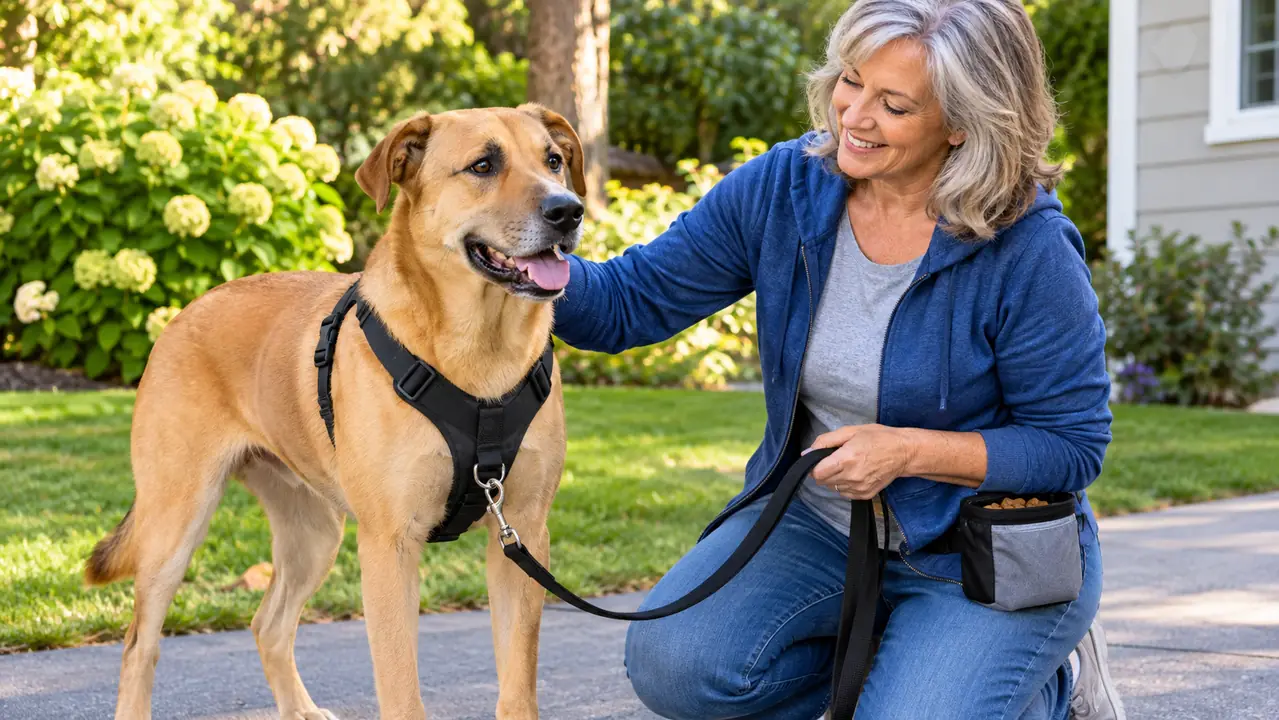
The Easy Walk has a ring at the chest and that is where the leash goes. Not the back, not the collar, not both. A leash clipped to the chest turns his forward pull into a sideways step. He cannot get his weight behind it. The martingale loop tightens gently across the shoulders when he pulls and eases the moment he stops, which is the whole feedback signal, and it works only if the leash is on that front ring.
The first walk with the front clip was not pretty. He zigzagged, he sulked, he stopped dead in the middle of the driveway and looked at me like I had rearranged his furniture. I had read that this happens and I still was not ready for it. A dog who has been pulling for most of a year has learned that pulling works, and the first walk where it stops working is confusing to him. I kept the walk short, maybe eight minutes, and I did not make a project of it.
What I did not do was go back to the back clip because the front clip looked awkward. That is the mistake I made with the harness before this one, and it cost me months. If it looks strange for a week, that is the harness doing its job and the dog complaining about it.
Step 3: Teach Him What the Pressure Means
The harness manages him. It does not teach him. The teaching happens with food and timing, and this is where the eBasics treat pouch earned its place. I wore it on my belt with a cup of kibble in it, and I still do, 22 months later. Before the pouch I used coat pockets and ruined two good coats with crumbs. The pouch opens with a magnet, stays open while I reach in, and holds far more than one walk's worth.
The other half of the timing was the HoAoOo clicker. Two came in the pack, one black and one blue, with a stretch spring wrist coil. The blue one lives on my wrist and the black one lives in the kitchen drawer as a spare. Biscuit worked out that click means a treat is coming in about three short sessions, five minutes each, in the living room with the harness off. I did not use it on a walk until he had that connection cold.
Here is the sequence that taught him the harness was not a punishment. I put the harness on, clicked, treated. I opened the front door, clicked, treated. I stood on the porch, clicked, treated. Nothing was asked of him in those first sessions except to stand there and be paid for it. That is not training the walk yet. It is buying a good attitude about the equipment before you ask for anything hard.
Step 4: Pay for the Position You Want, Not the Destination
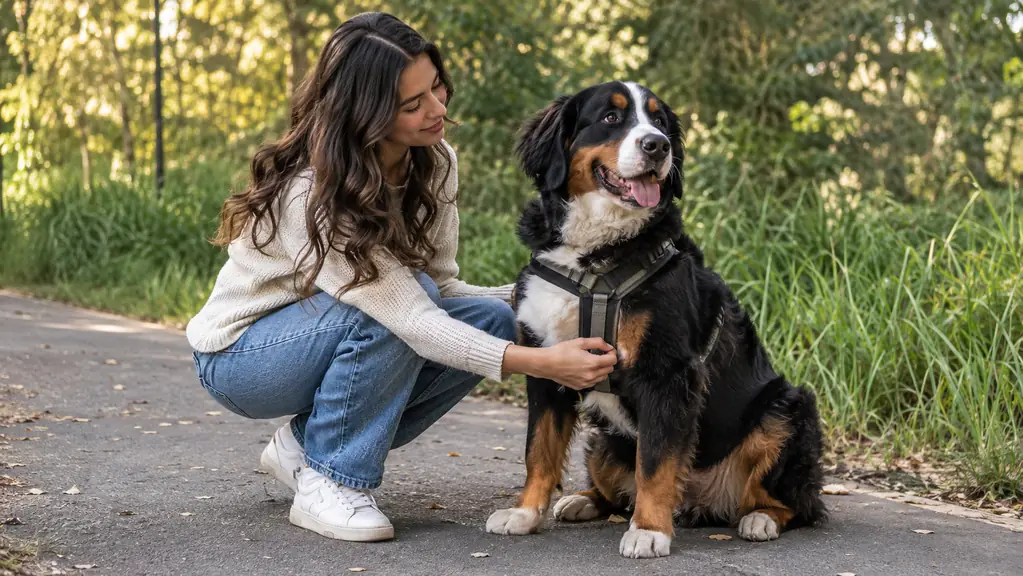
Biscuit pulled because pulling got him to the smell faster. The fix was to make the position beside me worth more than the smell, and that means paying often, especially at the start. On our first training walks, which were ten minutes on our own street and nothing more, I treated him every three or four steps when the leash hung slack. By the end of that week my left hand smelled like liver and my right shoulder had stopped aching.
The rule I used was simple. Leash goes tight, I stop. Not a jerk, not a correction, just stop and wait. When he turned back or stepped toward me and the leash went slack, I said yes and paid him. Then we moved forward again. Some blocks took us ten minutes. I told Ray he could not walk him that week because two of us doing it two different ways would have muddled the lesson, and Ray, who is a patient man, took the trash out instead.
The leash itself matters more than people think. I use an ordinary 6-foot leash on our twice-daily walks. A long leash in a training phase gives a dog room to build speed before the pressure reaches him, and that is the opposite of what you want. Six feet, one hand, treats in the pouch, and the same route for a week so the picture stays boring enough to learn in.
Step 5: Add Distance and Distractions One at a Time
Once our own street was calm, I moved to the greenway. Not both at once. First the same short distance on new ground, then the same ground at a longer distance, then a mild distraction like a parked stroller, then a hard one, which for Biscuit is any dog smaller than he is. Pulling eased in the first week with the front clip. Walks were calm by about week six. That is not the same as finished. Two years on, a squirrel can still get a rise out of him and I still reach for the pouch.
The 15-foot Hi Kiss long line is for recall practice only and I want to be precise about that. It clips to the back ring of a plain flat collar, never to the chest ring of the Easy Walk, because a long line on a front clip puts a sideways load on the harness and on his shoulders that it was not designed for. I use it at the greenway and in open grass, I wear gloves because nylon burns, and I never let him off it in an unfenced area. His recall in the yard was reliable after about eight weeks. At the greenway it took about five months, and I gave up on a retractable leash before I ever bought this one.
Add one variable at a time and give each one a week. New place, same distance. Same place, longer distance. Same place, one distraction. If it falls apart, you went too fast, and the fix is to go back a step for a few days rather than to push through. That is not a setback. That is the job.
What Else Helps
Have the vet look at him before you decide it is pure stubbornness. I asked Dr. Sellers at Biscuit's yearly exam whether anything physical could be driving the pulling, and she checked his neck and his hips and found nothing, which was worth knowing before I spent a year training around a problem that was not behavioral. If your dog is suddenly worse on leash, or reluctant on one side, that is a vet question, not a harness question.
Keep the equipment in its own lane. In our house the harness is for walks, the long line is for recall practice, the clicker is for new skills, the pouch carries the rewards, and the KONG belongs to alone time. He gets a large KONG stuffed with kibble and xylitol-free peanut butter, frozen overnight, when Ray and I leave the house. It lasts about 25 minutes and it did more for his barking at the mail truck around 1 PM than anything else I tried. A puzzle feeder lasted a week before I went back to the KONG. None of that is leash training, and none of it needs to be.
Two more small things. Walk him before the hardest part of his day rather than after, because a dog with a full tank pulls harder. And be boring and consistent. Same side, same six-foot leash, same words, same reward. PetSafe sells the harness, but the repetition is yours.
Pulling eased in the first week. By week six the leash hung slack on our own street. Two years on, I still carry treats and I still clip the leash to the front.
If your shoulder is the one taking the beating, start here
PetSafe Easy Walk, Large for dogs from 50 to 100 pounds. Front chest clip, martingale loop, hand wash only. Fit it, clip to the chest, and pay him for the slack leash.
Amazon Check Today's Price on Amazon →