
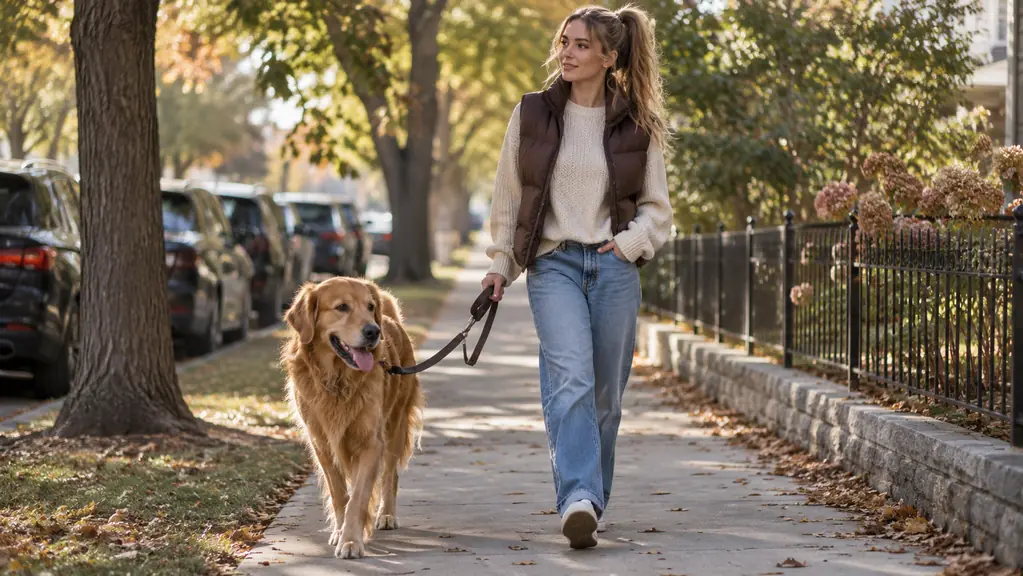
Biscuit came home from the shelter at 14 months old, 62 pounds of Labrador mix with no leash manners at all, and for the first three weeks he walked me. I mean that literally. He took me across a church parking lot at a trot while I held the leash with both hands and apologized to a man getting out of his truck. I was 55 then. I am 58 now, retired, and I spent most of my working life driving a school bus around Knoxville. I have never been what you would call a weak woman, but a 62-pound dog who has decided to go somewhere is a different kind of weight.
Here is what I tried first, in order: a flat collar, which he pulled against until he coughed and I hated it, a back-clip harness, which turned him into a sled dog because he could lean his whole chest into it, a slip lead a neighbor lent me for a week, and roughly nine hundred repetitions of the word no. Ten months later I bought the PetSafe Easy Walk in a size Large, mostly because a woman at the greenway had one on a dog twice Biscuit's size and that dog was walking with slack in the leash. I am not a trainer. I am not a vet and I do not play one here. I am a person who needed to get down the street without my arm coming out of the socket.
The harness that turned a tow rope into a walk
The PetSafe Easy Walk puts the leash on your dog's chest instead of his back, so a lunge turns him toward you instead of pulling you forward. That is the whole idea, and it is why this is still the only harness in my front closet.
Amazon Check Today's Price on Amazon →The leash clips to his chest, so a lunge turns him sideways instead of pulling you forward
A back-clip harness gives a pulling dog something to lean against. The clip sits behind his shoulders, so the harder he pulls, the more the pressure lands where he is strongest. On the Easy Walk the leash attaches at the front of the chest. When Biscuit hits the end of it, the leash draws his front end sideways toward me and he cannot get his weight behind it. The first time it happened he looked up at me like I had moved the mailbox, and then he walked forward again.
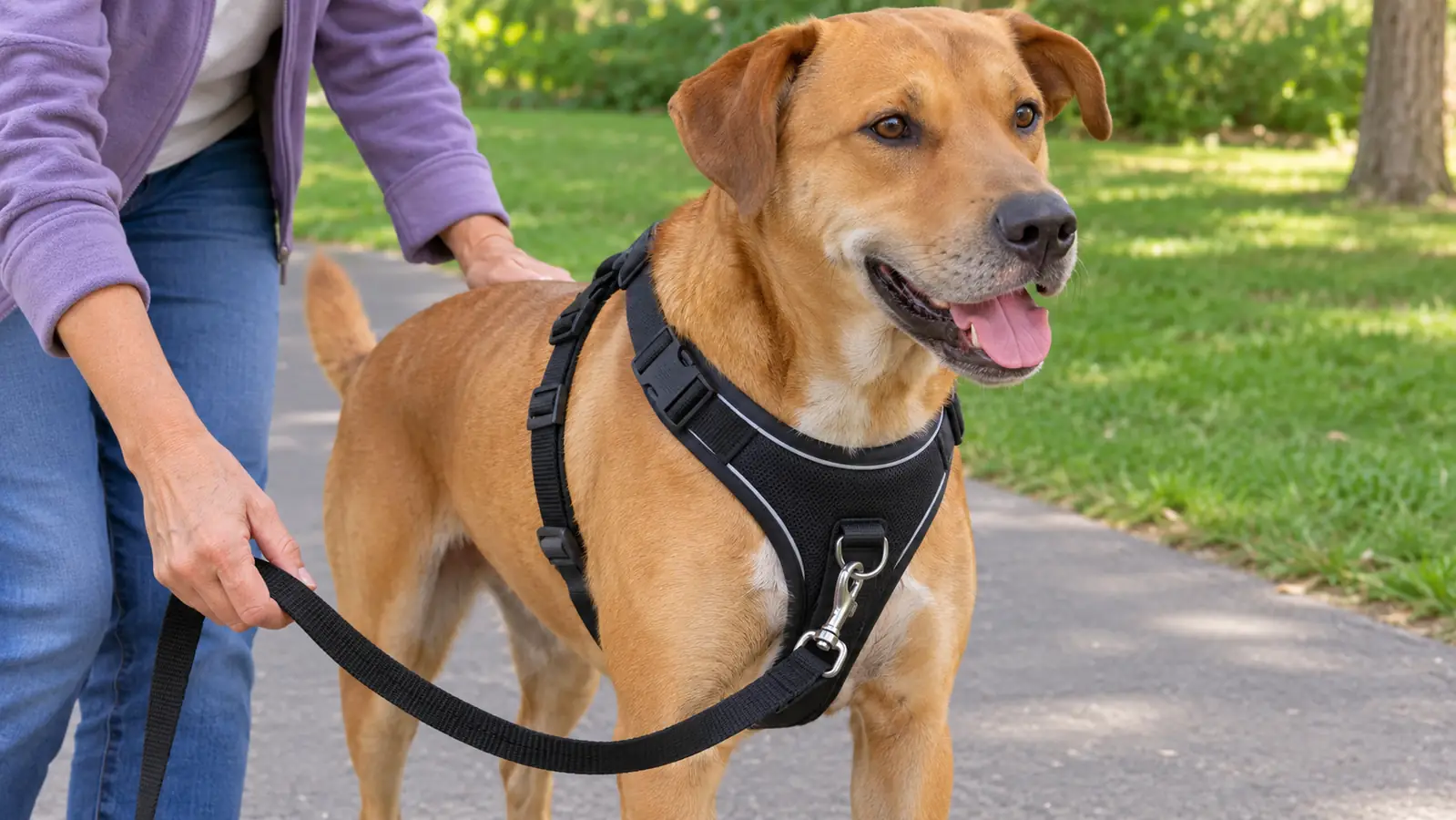
The martingale loop across the shoulders applies gradual pressure, not a choke
The front loop on this harness is a martingale, which means it draws in a little as the dog pulls and releases the moment he stops. PetSafe puts that pressure across the shoulders, not across the throat. I would not have bought anything that cinched his windpipe, and I looked at a lot of harnesses before this one. On Biscuit it works like a tap on the shoulder. He leans, the loop closes a little, he feels it, he slows. He has never coughed in it once.
Pulling eased in the first week, and I did not have to be the strong one
I want to be careful here, because I read a lot of claims that a harness fixed everything on the first walk. It did not. What happened is that the towing stopped in the first week. Biscuit could still pull, but he could not drag me anywhere I did not want to go. That difference changed my mood on the walk, and my mood turned out to matter more than I expected. I stopped being angry by the end of the block, and a dog who is not being yelled at is a dog who can learn something.
It made direction changes possible, which is where the training actually happened
With the back-clip harness I could not turn Biscuit. He was a 62-pound argument. With the front clip I could pivot him with two fingers. So I started doing what the books say. The second he hit the end of the leash, I stopped. When he looked back at me, I turned and walked the other way. Four or five of those in a row and he was watching me instead of the squirrel at the corner. The harness did not teach him that. It just made the lesson possible.
The buckle and the quick-snap shoulder straps get it on in about four seconds
I have owned harnesses that required a small engineering degree. This one has quick-snap shoulder straps and a buckle that closes under the belly. Two snaps and one buckle, and it is on. I do it in the dark by the back door, which is where I do most things at 6:40 in the morning. The straps adjust once and then stay where you put them, which matters on a dog whose weight moves around a few pounds depending on the season.
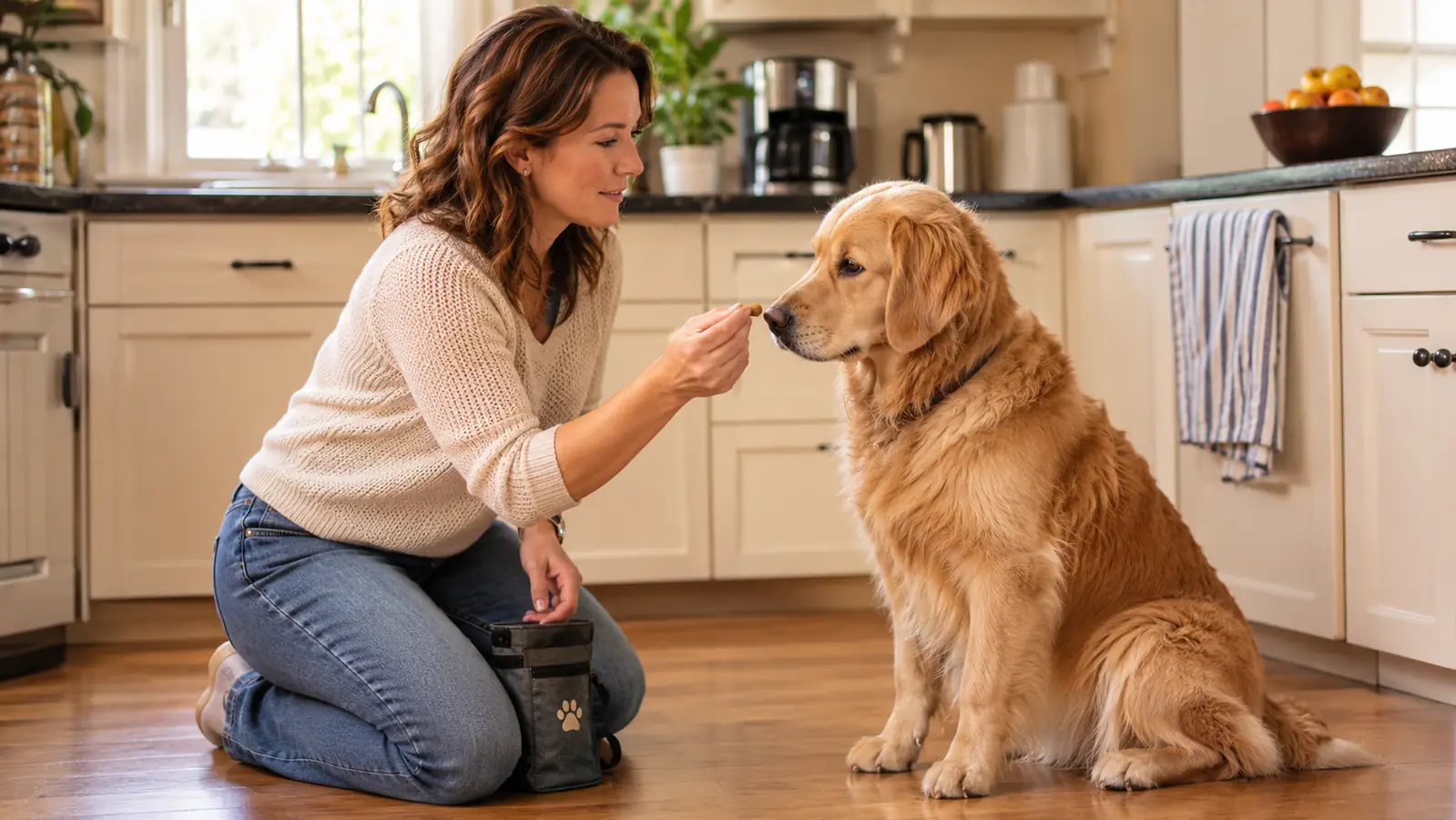
The belly strap is a different color from the rest, so I stopped putting it on upside down
This sounds like a small thing. It is not, when it is dark and the dog is spinning because he knows a walk is happening. The belly strap is a different color from the chest straps, so my eyes have something to check. The first month I had it, I put it on wrong twice and had to take it off in the driveway. I have not done it since. It also comes with a fitting guide, which I used once and then kept in a drawer, because Biscuit's chest measurement did not change after his second birthday.
It is built for 50 to 100 pound dogs, which is the range where pulling actually hurts
The Large fits dogs from 50 to 100 pounds, and Biscuit sits at 62, so he is not at the top edge of it. That matters more than it sounds. A harness that just barely fits a dog tends to rub behind the front legs or slide around on the walk. His has stayed put through two years of twice-daily walks, including the months when every single walk involved a great deal of stopping and staring at nothing. He is not a horse-sized dog. He is a medium-large dog with a low center of gravity and a strong opinion.
It works with the leash and the treats you already own
You do not need a special leash or a training kit to go with it. I use an ordinary 6-foot leash and a treat pouch with cut-up hot dog in it. The leash clips to the ring on the chest. Nylon webbing, a metal buckle, nothing electronic to charge and no batteries to replace. The care instructions say hand wash only, and I have hand washed it twice with dish soap and set it on the porch rail to dry. It carries a one-year limited warranty, which I have never had to use.
It gave me back the second walk of the day
Before the harness, Biscuit got one walk and a lot of yard time, because a second walk was more than my shoulder wanted to argue about. Now he gets two, morning and evening, usually the same route. The evening one is the good one. He is calmer by the time we come through the back door, and so am I. Ray has noticed that the house is quieter after 7 PM. I am not going to claim a harness fixed my dog's whole personality. I will claim it made the walk something I was willing to do twice a day.
It is a management tool, and being honest about that is why it worked
The harness does not train your dog. It stops him from practicing the pulling, which is a different job from teaching him not to. Biscuit was walking calm on a loose leash at about week six. The harness handled the first part of that, the part where I could keep him from dragging me while I taught him what I wanted. He is four now and he still wears it on every walk. If you want something that fixes the behavior while you do nothing, this is not that, and neither is anything else I have bought.
What I'd Skip
I would skip a back-clip harness if your dog already pulls, and I would skip the retractable leash entirely, which I say as someone who used one for months before I knew better. A retractable leash teaches a dog that the end of the leash keeps moving, and it puts a thin cord across the back of your hand. I would skip the slip lead a neighbor lends you. I would skip anything advertised as no pull that does not attach at the chest, because the attachment point is the entire mechanism. And I would skip buying this harness as a substitute for training. It buys you a calmer walk while you teach. That is worth what it costs, and it is not the same thing as a trained dog. If you want the long version of how I got from one to the other, I wrote about that separately.
Pulling eased in the first week. Calm walks took about six weeks. The harness did the first part, and the hot dog did the rest.
Start with the chest clip, then start the training
Two years in, the PetSafe Easy Walk is still the harness by my back door, and Biscuit still wears it on both walks. If your dog is walking you, this is where I would spend the money first.
Amazon Check Today's Price on Amazon →