
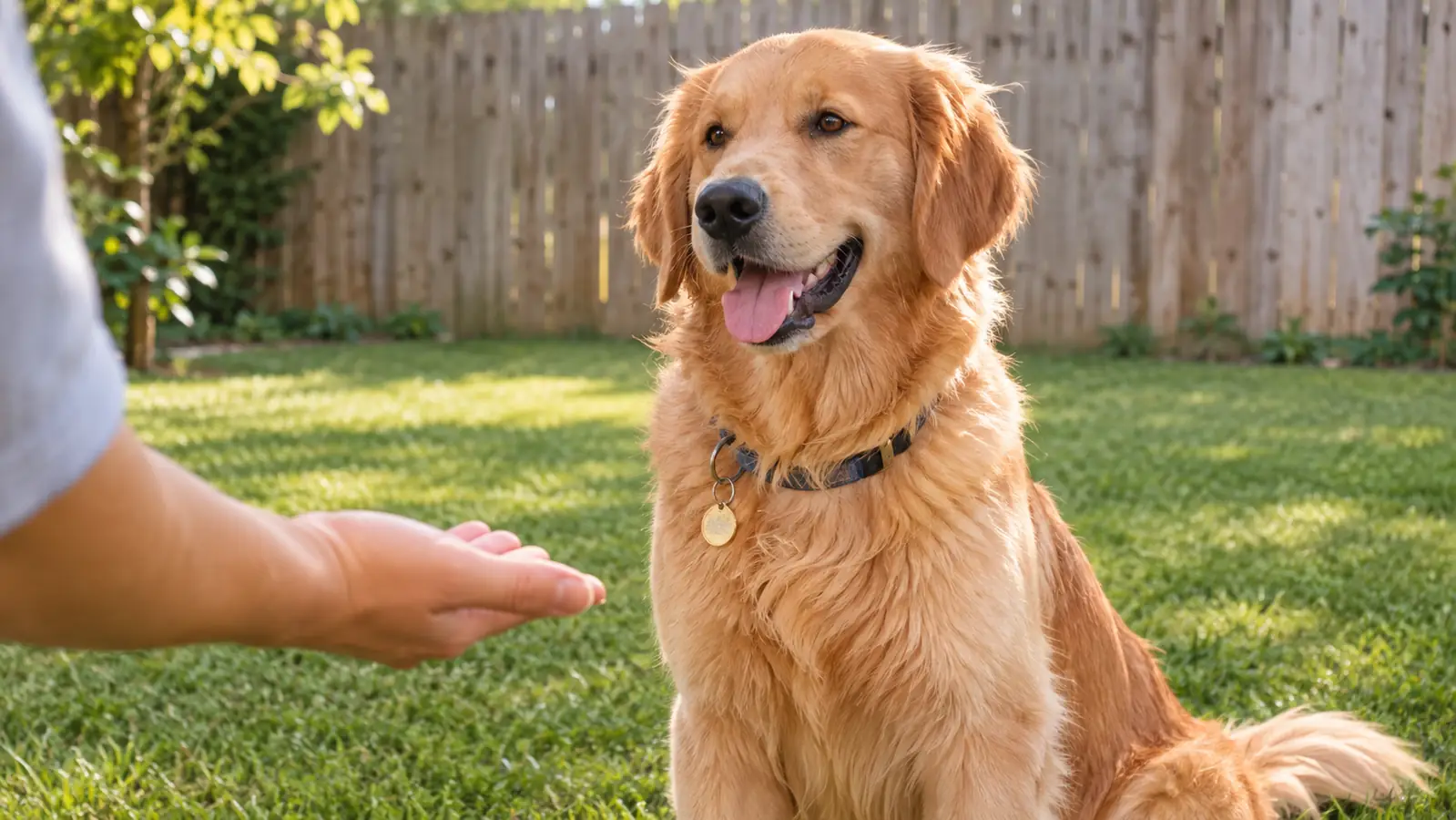
Biscuit was two years old when I finally admitted that the way I had been training him was not training at all. He was a 62-pound Labrador mix I adopted from a shelter at 14 months, and by the time he was two he could pull me down the sidewalk, launch himself at guests, and bark at the mail truck like it owed him money. I had spent fourteen months saying "no" and "eh-eh" and "Biscuit, stop" in a voice that got higher and more desperate each time. None of it stuck, because none of it told him what to do instead.
What changed things was a two-pack of HoAoOo clickers that cost less than a bag of dog food. I am not a trainer. I am 58, retired from decades of driving a school bus, and I live in a small one-story house in Knoxville with my husband Ray and one dog. But I can tell you what happened in my own yard over about 20 months, and I can tell you the five steps that actually got us from "he has no idea what I want" to "he hears the click and turns around." That is what this is.
The two-pack of clickers that started all of this
Two clickers, one black and one blue, each on a stretch spring wrist coil so you are not digging through your pocket mid-session. This is the exact set Corinne keeps on her wrist and in her kitchen drawer.
Amazon Check Today's Price on Amazon →Before You Start: What the Clicker Actually Does
Here is the whole idea in one sentence. The click is a promise that a treat is coming, and it marks the exact half-second you want to reward. That is it. It is not a remote control and it does not correct anything. A click never means "stop that." It only ever means "yes, that, right there, and here comes food."
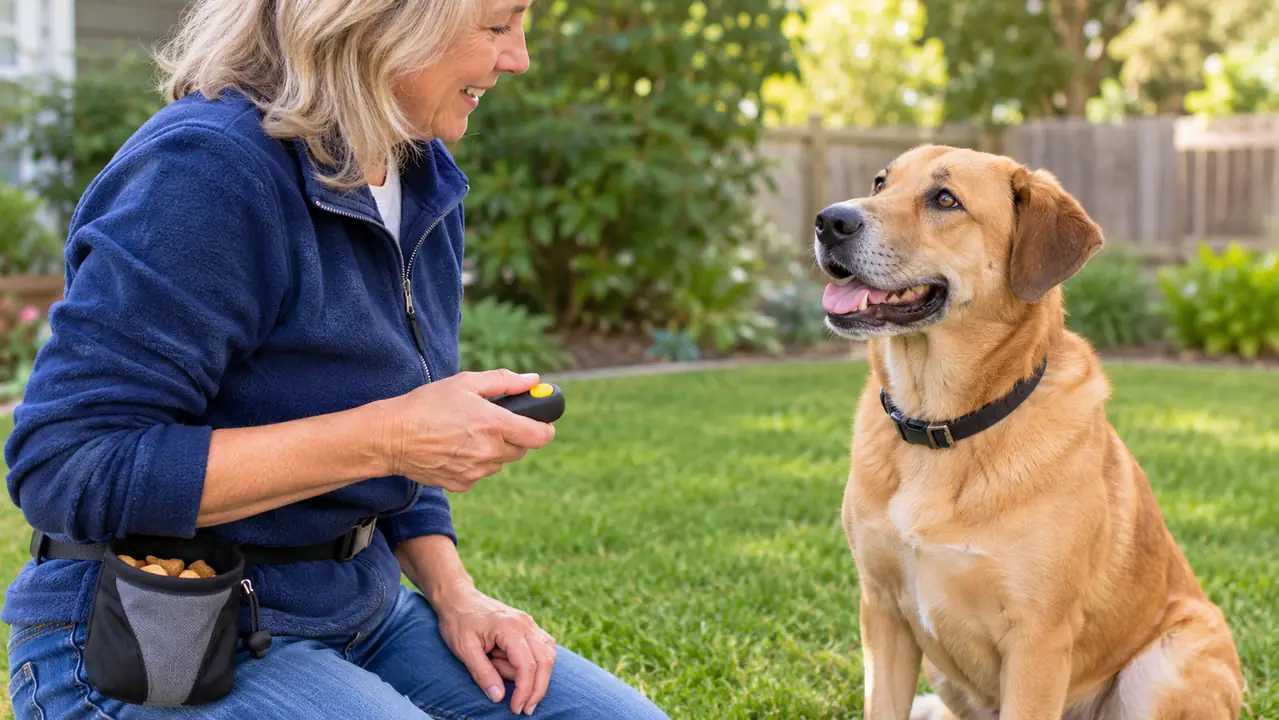
That distinction matters more for an adult dog than a puppy. A puppy is a blank page. A two-year-old dog has a lifetime of experience telling him that humans make noise and the noise means nothing in particular. So your first job is not teaching a behavior. It is teaching him that the click is worth listening for. In my house that took three short sessions over two days, maybe four minutes each. The HoAoOo clicker has a press-down tab that is easy on the thumb, and the wrist coil meant I stopped setting it down and losing it.
One caution from Dr. Sellers, my vet. She asked how much I was planning to feed during training and told me to take it out of Biscuit's meals rather than adding it on top. A 62-pound dog doing three sessions a day will eat a lot of tiny treats. I started measuring his breakfast into a container and using that as the day's reward supply. His weight stayed steady, which it would not have otherwise.
Step 1: Charge the Clicker Before You Ask for Anything
Charging the clicker means pairing the sound with food until the sound itself makes your dog's ears come up. No commands. No sit. No expectations at all. You click, you treat, you wait two seconds, you click, you treat. Ten clicks per session, three sessions a day, and stop while he is still interested.
The timing trick that took me a few tries to get right: treat first, click second is wrong, but so is clicking and then fumbling in a pouch for eight seconds. Click, then deliver within about a second. That is the whole reason I started wearing a treat pouch instead of using my coat pockets, which I had ruined twice with crumbs. The eBasics pouch I have used for 22 months now has a magnetic opening I can get a hand into one-handed, and it holds up to three cups, so I am not refilling mid-walk.
How do you know it worked? For Biscuit, day one he yawned at me. Day two he started turning his head toward the click. By the third session he was following my hand, waiting for the sound. When your dog startles at the click and then looks at your hand for food, you are done charging. Move on.
Step 2: Pick One Skill and One Skill Only
The most common mistake I made early was trying to fix everything at once. Pulling on leash, jumping on guests, the mail truck, all in the same week. That is not training, that is chaos with treats. Pick one behavior that is small enough to happen in a single session and reward the daylight out of it.
For Biscuit I picked "four feet on the floor when the doorbell rings." Not because it was the most urgent problem, but because it was the one I could set up ten times in a row in my own living room. Sit is also a fine first skill. So is a hand touch, or coming when called in a hallway. What you are looking for is repetition you can control, not the biggest problem in the house.
Write it down as one sentence before you start. Mine was on a sticky note on the fridge: "Click and treat when all four paws are down." If you cannot fit it on a sticky note, it is two skills wearing one coat.
Step 3: Catch the Behavior, Do Not Lure It Forever
There are two ways to get a behavior in front of you. You can lure it with a treat in your hand, or you can wait for the dog to offer it. Luring is faster at first and it can become a trap. I lured Biscuit into a sit for about two weeks and then discovered he would only sit if he could see my hand doing the scooping motion. I was not training a sit. I was training a hand signal I did not intend to give.
The fix is to fade the lure fast. Lure once or twice, then stand there with empty hands and wait. This is the part that requires patience, and it is the part that separates a fifteen-minute session from a four-minute one. If the dog does nothing for 30 seconds, go back to a lure for one rep, then wait again. When the behavior happens on its own, click the instant it happens, not after you have gotten excited about it.
Your half-second matters. If you click as his rear is still going down, you have marked "start to sit." If you click after he is seated and settled, you have marked the whole thing. Both work. What does not work is clicking a full two seconds late, when he has already stood back up, because then you have marked standing.
Step 4: Add a Word, Then Retire the Clicker for That Skill
Once a behavior is happening reliably, you put a cue on it. Say the word once, wait for the behavior, click and treat. Do not repeat the word four times, and do not say it while the dog is already doing the thing, because then the word becomes decoration.
Here is where the clicker's job actually ends. In my house, the clicker is for new skills only. For everything Biscuit already knows, I use the word "yes" as my marker. That is a deliberate split and it kept me from carrying a clicker on every walk forever. The click is a fresh, precise sound with no emotional baggage behind it, which is why it teaches fast. "Yes" is what I already say a hundred times a day anyway, so it is the practical everyday marker once the behavior is learned.
You will know a skill is ready for retirement when you can get it in a noisy place, on the first ask, without a treat visibly in your hand. That is not a fixed timeline. Biscuit's doorbell behavior took about six weeks before I trusted it around actual guests, and I still reward it maybe half the time because a behavior that stops paying out stops happening.
Step 5: Raise the Difficulty in Small Jumps, One Variable at a Time
A dog does not generalize well. Biscuit could sit perfectly in my kitchen and had no idea that sitting was also a thing that could happen on the sidewalk in front of the neighbor's house. This is normal and it is not stubbornness. It just means the skill has to be re-earned in each new place, and each new place should be one small step harder than the last.
My order went: kitchen, living room, back yard, front porch, quiet sidewalk, busy sidewalk. At each new place I lowered my expectations and paid better. If he failed twice in a row, we went back a step rather than pushing through. That rule saved me a lot of frustration. Failure in a training session is information, not defiance.
For anything that involves distance or the outdoors, I use a 15-foot long line, never a retractable leash. I gave mine away before I bought the long line and I have not missed it. The long line clips to the back ring of Biscuit's plain flat collar, not to the front chest ring of his Easy Walk harness, and I wear gloves because a nylon line running through bare hands will burn you. Fifteen feet is enough room to practice a recall without giving up control. I do not let him off line anywhere unfenced, and I would tell you the same thing if you asked me at the greenway.
Failure in a training session is information, not defiance. If he missed it twice, I made it easier instead of saying it louder.
What Else Helps
Reward supply is the thing nobody warns you about. A dog will work for kibble in the kitchen and then look at you like you have lost your mind when you offer kibble on the sidewalk. I keep three tiers: ordinary kibble for easy reps at home, small soft treats for new skills, and something genuinely high value, usually a bit of plain cooked chicken, for the hard stuff like recall at the greenway. The eBasics pouch holds all three without turning into a mess, and I wear it on my belt for yard sessions and on walks.
Sessions should be short and they should end well. Four to five minutes is plenty for an adult dog learning something new, and I always stop on a success, even a small one. If a session is going badly, I ask for something he knows, pay it, and quit. That is not giving up, that is protecting the next session. Two short sessions a day beat one long one every time, and I have tested that on Biscuit more than once by accident.
Also worth knowing: the clicker is a training tool, not a management tool. It did nothing about Biscuit's pulling on the sidewalk, because pulling is a habit that happens at a speed where I cannot click in time. That is what his front-clip harness was for, and the two things did different jobs in my house. The clicker taught new skills. The harness made the walk survivable while we got there. If you mix those up, you will be disappointed in the clicker for a job it was never meant to do.
And for the hours when you are not training at all, keep something else in the routine. Biscuit gets a KONG stuffed with kibble and xylitol-free peanut butter, frozen overnight, when Ray and I leave the house. It lasts about 25 minutes frozen and it gave him something to do at the hour he used to spend barking at the mail truck. I tried a puzzle feeder once and went back to the KONG. It is not a fix for real separation anxiety, and if your dog is panicking when you leave, that is a call to your vet, not a clicker problem.
I have owned the blue HoAoOo clicker for about 20 months and it lives on my wrist during sessions. The black one sits in the kitchen drawer as the spare, which turned out to be the point of the two-pack, because I lost the first one in the yard for four days. If you are starting with an adult dog who has never heard a marker, one clicker and a bowl of measured kibble is genuinely all you need for week one.
Start with the 3-session charge, not the whole program
Two clickers with stretch spring wrist coils, one for your wrist and one for the drawer. Charge it with food for three short sessions and you will know by day two whether your dog is listening.
Amazon Check Today's Price on Amazon →