
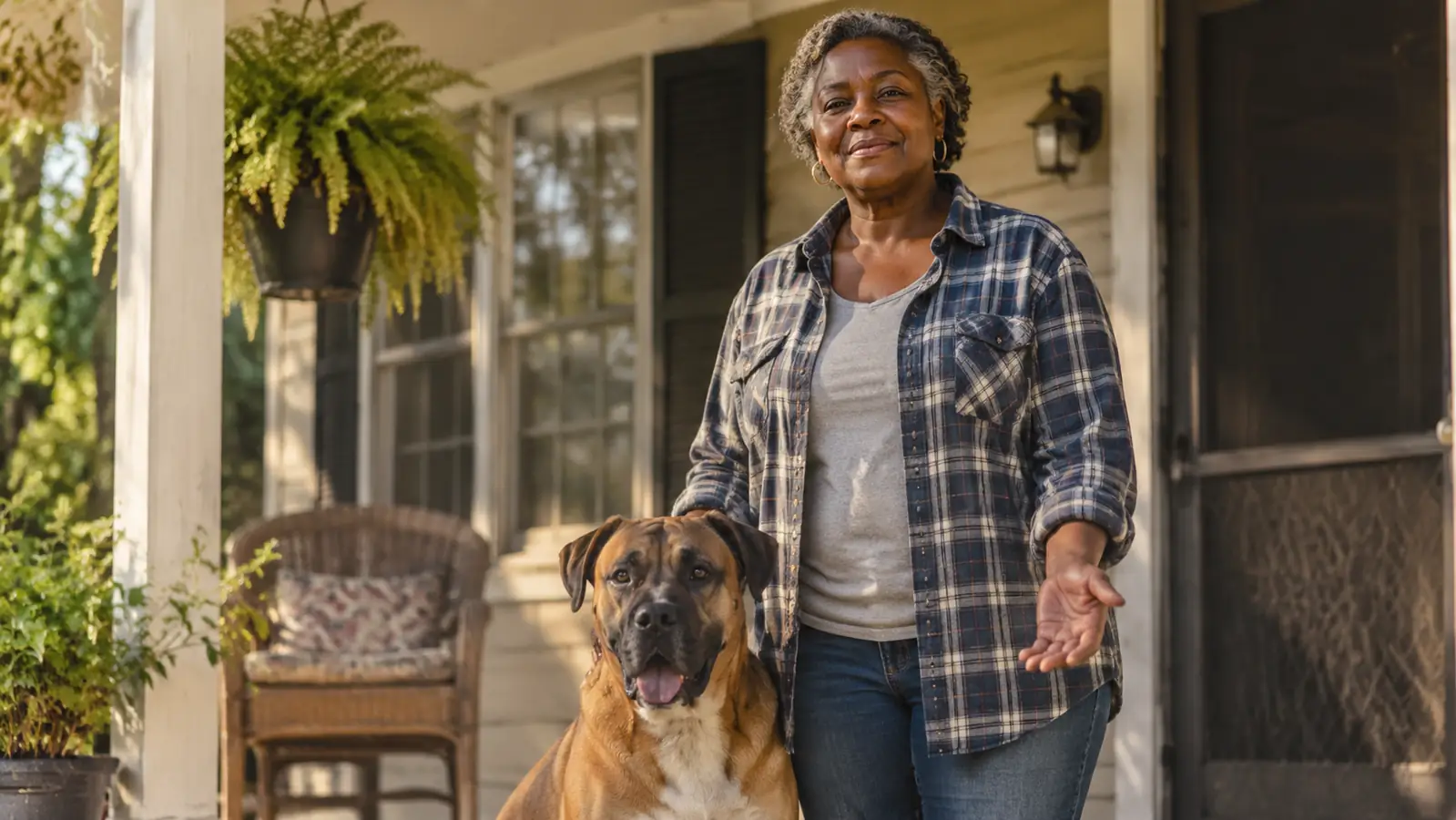
I said "sit" about four hundred times in my first month with Biscuit, and he heard a sound. Biscuit is a 4-year-old Labrador mix, 62 pounds, and I adopted him from a shelter at 14 months old. He pulled hard on leash, jumped on guests, and barked at the mail truck every afternoon around one. I talked to that dog in whole sentences. I gave him encouraging little speeches in the kitchen. What he took from all of it was the general tone of my voice.
A friend who trains bird dogs told me the plainest thing I had heard in months. To a dog, a word is just a sound you make a lot, and most of my sounds meant nothing in particular. What Biscuit needed was one sound that meant exactly one thing, made the same way every time, and always followed by food. That is what a clicker does. Nothing more, nothing less. I bought the HoAoOo two-pack twenty months ago and I have used it nearly every day since.
The Quick Verdict
A pair of press-and-click markers that fixed the one thing my voice could never do fast enough. Biscuit had the rule in three short sessions. The wrist coil is the part I did not expect to love.
Amazon Check Today's Price →One press marks the exact second your dog does it right
You do not need a louder voice. You need a sound that lands in the same breath as the behavior, every single time.
Amazon Check Today's Price on Amazon →How I've Used It
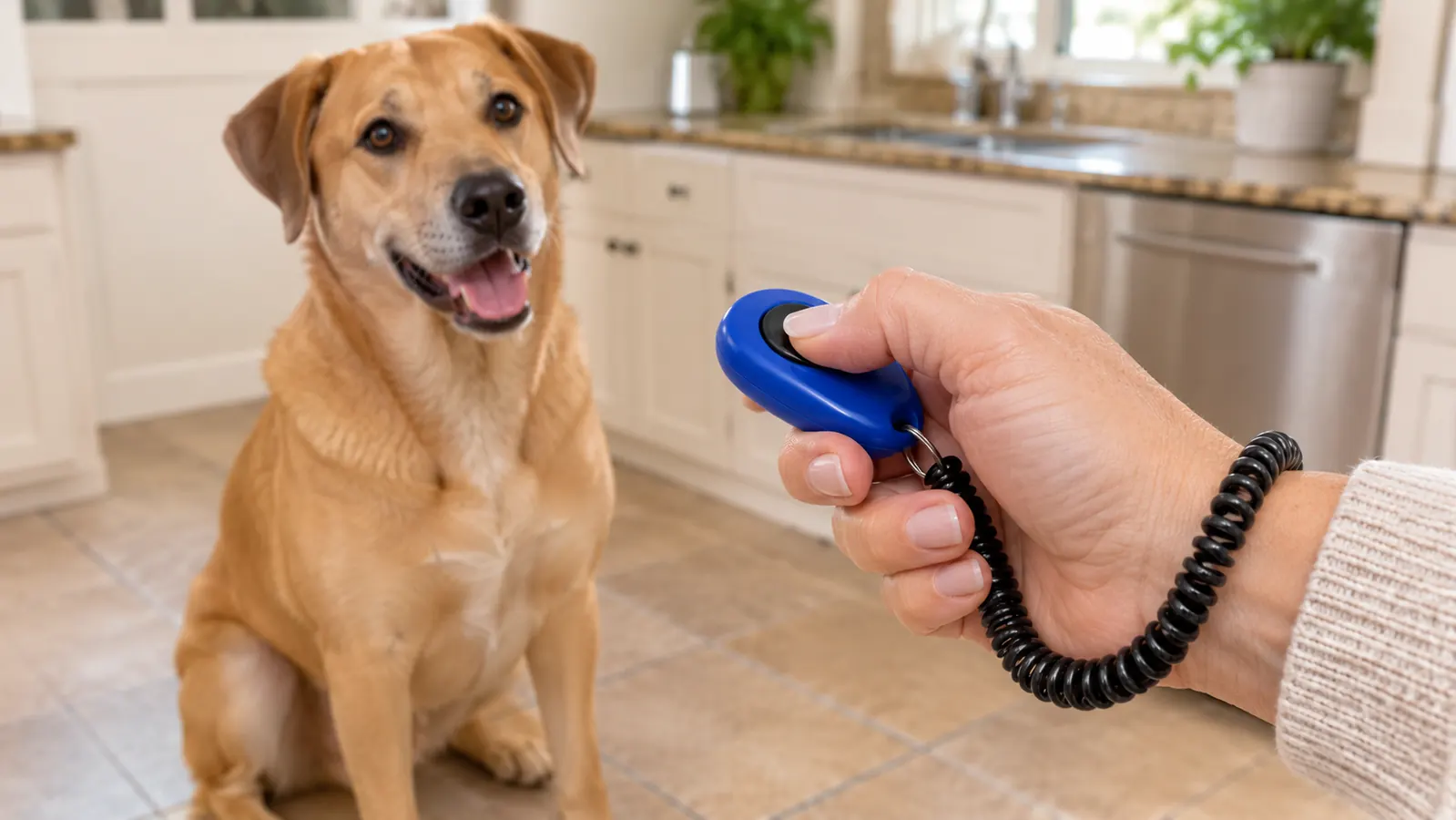
It lives on my wrist. That is the whole reason it works. The HoAoOo comes as a pair, and I keep one on my left wrist with the stretch spring coil and the other in the kitchen drawer as the spare. The coil sits around six inches relaxed and pulls out to nearly ten, so it slides over my hand without a fight. The whole thing weighs an ounce and a half. I forget it is on until I need it.
The first two weeks I clicked far too much. Every time Biscuit looked at me I clicked and paid. He started offering me a sit every ten seconds because sitting had become the price of eye contact, and he put on a little weight. That was my mistake, not the tool's. A click is a promise that food is coming. Click forty times on a walk and you have made forty promises, and your dog will spend the rest of the day trying to work out which one he earned.
Twenty months in, I use the clicker for new skills only. A hand touch, settling on a rug while Ray eats his lunch, waiting at the back door instead of barging through it. For everything Biscuit already knows, I say "yes" and pay him anyway. Keeping the clicker for new work is what keeps it sharp. If it fired all day long it would stop meaning much of anything.
There is a keyring on the end of each one. I have never used it. It would clip to a belt loop or a pouch strap if you are the type who plans ahead, which I am not.
The coil has held up better than I expected. Twenty months of being stretched over my hand twice a day and it has not gone slack or lost its spring. I did get it wet in a drizzle on a greenway walk last spring, and it dripped on my sleeve for the rest of the mile and a half, which is a small thing and the only complaint I have ever had about the strap itself.
The two-pack has turned out to matter more than I expected. A single clicker would have lived in a pocket and gone through the wash, or ended up on the kitchen counter while I was out in the yard with a dog who was doing everything right and getting paid late for it. Having a second one means there is always one within arm's reach. I have never had to stop a session to go hunt for it, and over twenty months that is worth something.
What the First Three Sessions Looked Like
Session one lasted about four minutes, in the kitchen, with a bowl of kibble on the counter. I clicked and fed. Clicked and fed. Nothing was being taught yet. I just wanted the sound to predict food the way a dinner bell does. By the end of it Biscuit's ears were up at every click and his eyes were on my hand. Dr. Sellers had told me to keep sessions under five minutes and stop while he still wanted more, and I have followed that advice for over a year without regret.
One thing I would tell anyone starting: do it before a meal, not after. My first attempt was a Sunday morning when Biscuit had already eaten, and he looked at the kibble like I had insulted his family. He took one piece and walked off to the living room. The next evening, an hour before his dinner, he would have done arithmetic for a single piece of kibble. When you run the session matters about as much as when you click.
Session two, I waited for a behavior he offered instead of one I asked for. He looked at the floor. Click, feed. He looked up at me. Nothing. He looked at the floor again, harder this time. Click, feed. Four minutes of that and I could see the wheels turning. By session three he was dropping his nose to the floor on purpose, and a week later I put the words "find it" on it.
Three sessions, maybe twelve minutes in total, and he had the rule. This is a dog who took almost five months to stop lunging at bicycles. I am not telling you the clicker made him clever. I am telling you that marking the exact half second a dog does the right thing is a different act from saying "good boy" a second and a half later, and Biscuit could tell the difference even when I could not.
The fourth session is where the real teaching started. Once he was offering the nose-to-floor behavior on purpose, I added the words right before he did it and clicked the instant his nose went down. It took maybe twenty repetitions spread over three days before the word alone would start him. That sounds slow written out. In the kitchen, four minutes at a time, it felt like the fastest thing I had ever taught a dog.
Three short sessions, about twelve minutes in total, and he had the rule. This is the same dog who took nearly five months to stop lunging at bicycles.
The Timing Problem Nobody Warns You About
Here is where I got humbled. Your voice is slow. I would say "good" and by the time the word left my mouth Biscuit had already moved on to sniffing the baseboard, so I was paying him for sniffing. The click happens in the same breath as the behavior. It holds that second still long enough for the food to arrive afterward.
Late is not the only way to get it wrong. Early is worse. If you click while your dog is on his way up out of a sit, you have marked the getting up. I did that for a week with "down" and could not work out why he would lie down and then pop straight back up. Ray watched me from the porch one evening and said, "You're clicking the wrong end of it." He was right, and I hate that he was right.
The fix, for me, was to click first and move my hand to the food second, never the other way around. And to keep the food in the pouch instead of in my fist, so Biscuit was reading the task and not my hand. Twenty months in I still catch myself clicking a beat late when I am tired. It is a skill, and like any skill it gets sloppy at the end of a long day.
For the first month I counted. Twenty clicks a session was my ceiling, and it kept me honest. Ray would sit on the porch step with a glass of tea and count along out loud, which was irritating and also the reason I finally slowed down. If I could not tell him what Biscuit had just done to earn click nineteen, then click nineteen had been a waste of good kibble.
Where a Clicker Stops Helping
The clicker is a teaching tool, not a management tool. It will not stop a 62 pound dog from dragging you down the sidewalk. That job belongs to the front-clip harness, and no amount of clicking replaces it. For Biscuit, the harness handled the pulling and the clicker handled the new skills I wanted to build on top of a calm walk.
It also does very little for a dog who is already over threshold. If Biscuit is barking at the mail truck, the window for marking anything useful has closed. The click lands, the food lands, and what he learns is that barking and eating go together. I learned to work at a distance where he could still hear me, and to save that hour of the day for a frozen KONG instead. Enrichment is not training, and it is not supposed to be.
The mail truck taught me that the hard way, back in the fall. For two weeks I tried to click and pay Biscuit when he noticed the truck and then looked back at me instead of barking. It worked in the living room with the window shut. It fell apart on the porch. Too much distance, too much noise, too many triggers arriving at once. I went back to working him from the far end of the hallway, six or seven feet from the glass, and built the whole thing up from there over about a month.
Two smaller things worth saying out loud. The click is not quiet. In a house with a sleeping husband, or on a greenway with other walkers around, a sharp click carries, and I have muffled one in my pocket more than once. It still marks the second, just with less drama. And you need food on you at all times, which is a separate problem the clicker does not solve.
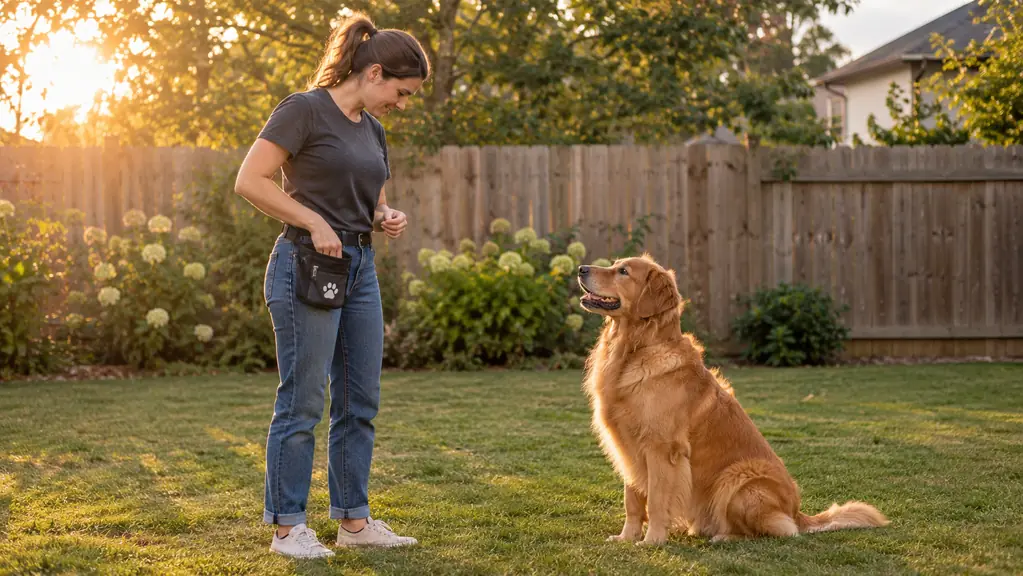
That separate problem is why the treat pouch lives on my belt now. Before I had one I used coat pockets, and I ruined two good jackets with crumbs and grease before I gave in. Standing in the yard with a hand in a pocket, digging for a piece of kibble while the moment passes, is its own kind of slow. The pouch keeps the payment where my hand expects it, and that keeps the whole sequence tight.
What I'd Do Differently Starting Over
If I could walk back into the week I brought Biscuit home, I would do three things differently. I would charge the click with food for a full session before pointing it at any behavior at all. I would pick one skill at a time instead of running three because I was excited. And I would wear the clicker on my wrist from day one, because the one in my pocket was always the one that had gone missing somewhere in the yard.
The bigger change would be in what I expected from it. A clicker makes a new behavior clear faster. It does not make a dog reliable. Recall is the honest example. Biscuit was solid in the fenced yard after about eight weeks and steady out at the greenway after about five months, and most of that was repetition on a 15 foot long line clipped to the back ring of a flat collar, not clicking. The HoAoOo pair shortened the part where he was guessing. The long line and a few hundred ordinary afternoons did the rest.
I also would have asked Dr. Sellers my questions earlier than I did. I spent most of a month guessing at why Biscuit would do a perfect sit in the kitchen and a sloppy one out in the yard, and her answer was a single sentence: the yard has squirrels in it and the kitchen does not. That is not a clicker problem. That is me expecting the same dog in two different places.
I would also stop apologizing for the four minute sessions. I spent my first months thinking real training meant a long, serious block of time in the yard, and that if I only had ten minutes I should skip it. Ten minutes, split into two, is plenty when the dog is learning something new. Most of what Biscuit knows was built in the gap between putting my boots on and heading out the door.
What I Liked
- Two clickers in the pack, so one stays on my wrist and one lives in a drawer as a spare
- The stretch spring coil slides over a hand easily and stays put through a whole session
- The click is immediate, which is the one thing my voice could never be
- Light enough at an ounce and a half that I forget I am wearing it
- Biscuit connected the sound to food inside a single four minute session
Where It Falls Short
- It is a marker, not a fix. It did nothing at all for pulling on leash
- The click is loud enough that I have muffled it in my pocket around other people
- It is very easy to click too much in the first week and pay for nothing
- The keyring on the end is useless to me, though I can see how someone more organized would use it
Who This Is For
This suits a dog who hears a great many words and follows very few of them. It suits an adult dog who will work for plain kibble, and an owner willing to stand in the kitchen clicking at a dog for four minutes and then put it away. If you have already tried saying "no" louder and found that it changes nothing, you are exactly who this was built for.
Who Should Skip It
Skip it if the thing you actually need is a way to walk a dog who pulls. A clicker will not fix that, and buying one first will leave you frustrated on the sidewalk. Skip it if your dog will not take food once he is outside the house, because you cannot pay a dog with something he does not want. And skip it if you want a piece of equipment that does the work while you think about something else. It marks the moment. You still have to be in the moment.
If your dog hears paragraphs and follows almost none of them
Twenty months and one spare clicker in a kitchen drawer later, this is still the first thing I reach for when I want to teach Biscuit something new.
Amazon Check Today's Price on Amazon →