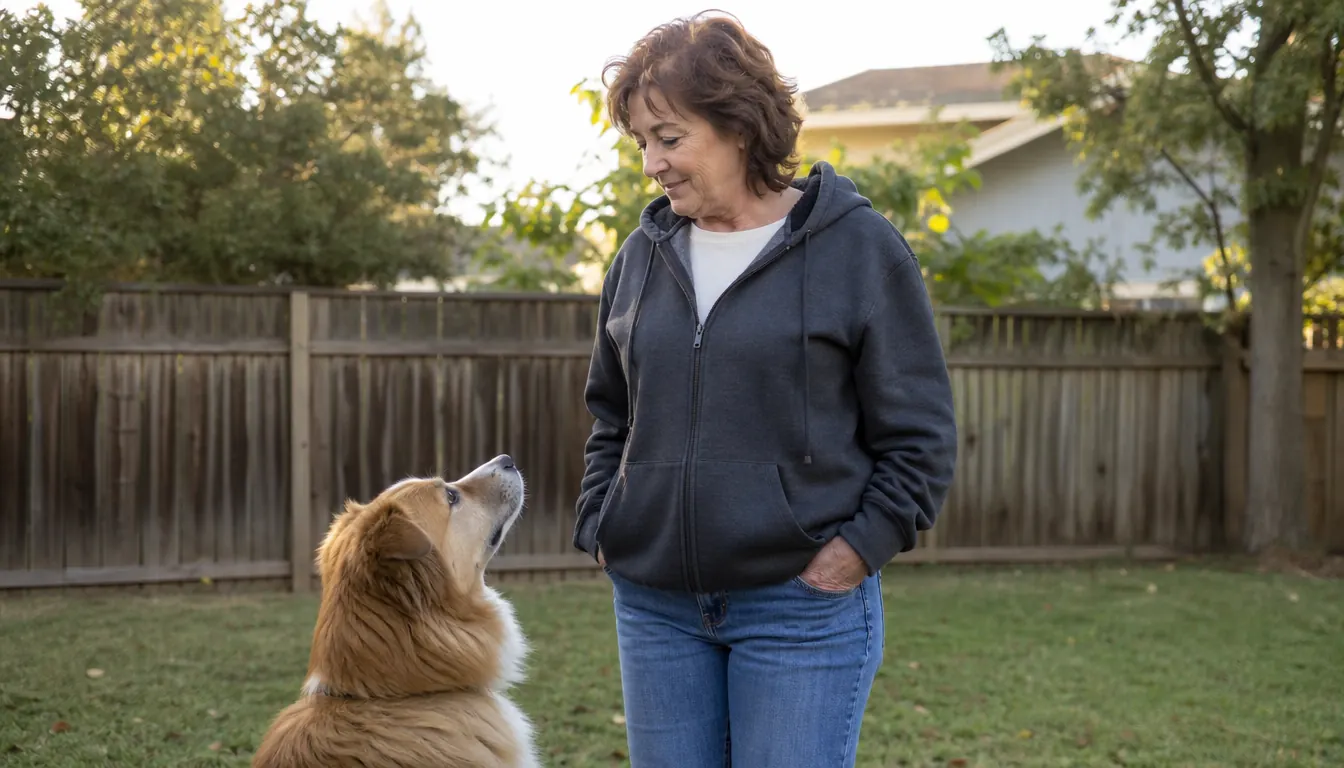
Biscuit learned to sit in about four minutes. It took me another four months to learn how to pay him. That sounds like a joke and it is not. For the first year I had him, I did what almost every owner does. I would ask for a sit, he would sit, and then I would dig through my coat pocket for a piece of kibble while he watched my hand with his ears falling. By the time the food got to his mouth he had stood up, sniffed the grass, and forgotten the whole transaction. I was not rewarding the sit. I was rewarding the standing up. He was a young Lab mix from the shelter with 62 pounds of pull in him, and I was teaching him that good things arrive late and by accident.
What fixed it was not a training philosophy. It was a piece of gear and a habit. I bought the eBasics treat pouch 22 months ago for the plain reason that my coat pockets were full of crumbs and my hands were too slow. The treats moved from my pocket to my belt, and my delivery got fast enough to actually land on the behavior I wanted. That is the whole thing in one sentence. If you are trying to reward good behavior and it keeps not sticking, the problem is usually not your dog's understanding. It is the two or three seconds between the good thing and the payment. This is how I closed that gap, in my own back yard, with a dog who is not a border collie and an owner who is not a trainer.
A late treat teaches a late lesson. Put the food where your hand already is.
The eBasics treat pouch holds up to 3 cups, opens one-handed on a magnetic closure, and goes on an included belt or clips to your waistband. It is the difference between a reward that lands while the dog is still doing the thing and a reward that shows up after he has moved on.
Amazon Check Today's Price on Amazon →Step 1: Put the Treats Where Your Hand Already Is
Almost every late reward I have seen is not a discipline problem. It is a reaching problem. If the food lives in a bag on the counter, or in a zippered pocket, or in a coat you are not wearing, then every single reward starts with a small journey and ends with a dog who has moved on to something better. You cannot out-patient a bad setup. You can only shorten the journey until it is nothing at all.
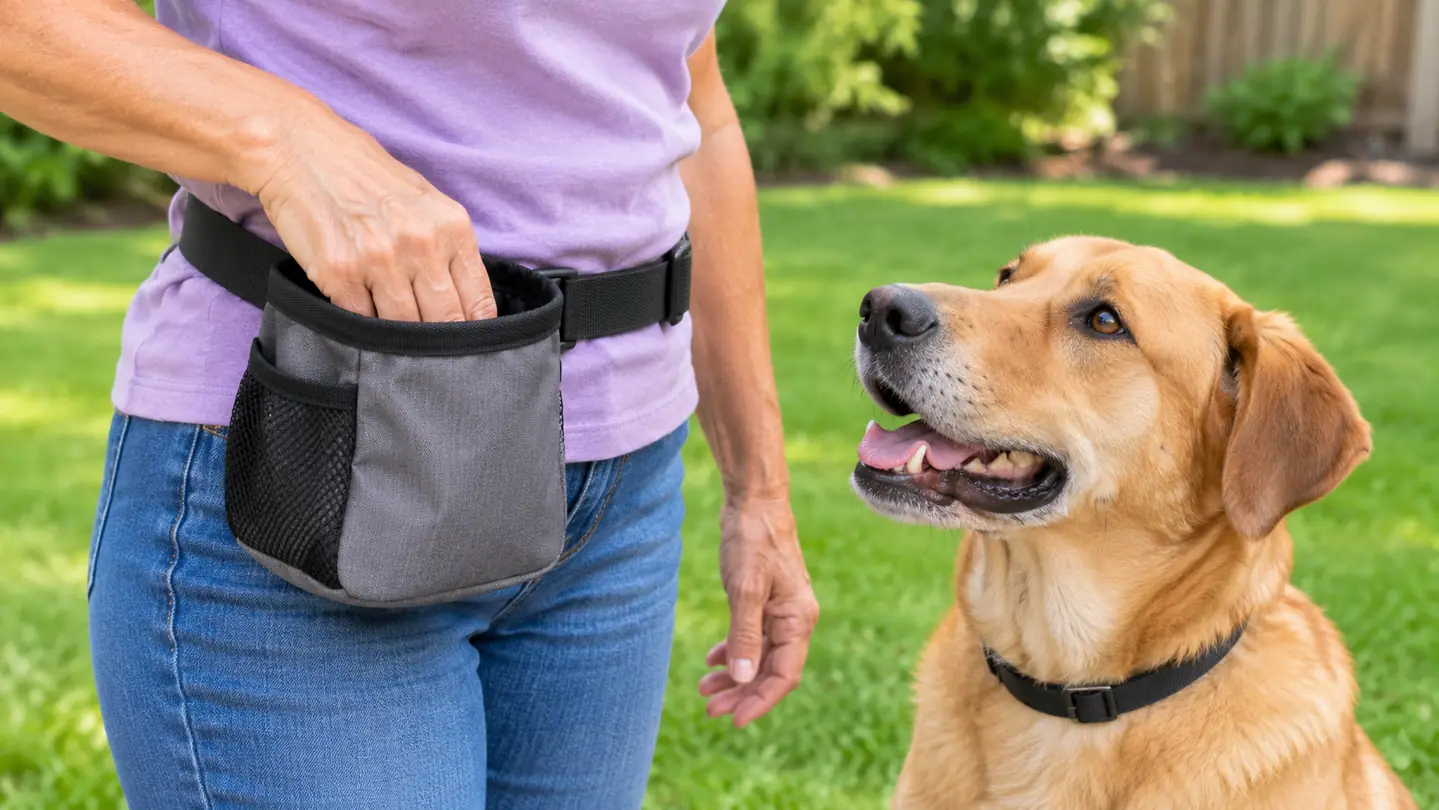
I wear the eBasics pouch on the included belt for walks, and I clip it to my waistband in the yard. The belt runs to about 50 inches, so it sits where I want it, which is on the front of my right hip, the same side as the hand that hands things out. The pouch is 5 inches wide, 5.5 inches high and 3 inches deep when open, and it holds up to 3 cups of treats, which is more than enough for a 20-minute session. The opening is magnetic, so I can get a hand in and out without looking and without unzipping anything. It is 900 denier polyester, which is backpack material, and it has spent 22 months being dragged past hedges and dropped on a patio without a tear in it.
Before this pouch I used coat pockets. I ruined two coats that way, one with grease from cut-up hot dog and one with crumbs worked into the lining, and after all that I was still slow. Empty the pouch at the end of every session, by the way. Old treats at the bottom go soft and a dog who is working for stale kibble dust is not a dog who is working hard.
Step 2: Mark the Behavior Before You Reach
The mark is the word or the sound that tells your dog, at that exact instant, that this is the thing being paid for. I use one word as my marker, and the word is yes. For anything Biscuit already knows, yes is enough. For anything brand new, I use a clicker. Mine is a HoAoOo, sold as a two-pack, and the blue one has lived on my wrist for 20 months. The black one sits in the kitchen drawer as the spare.
The reason the mark matters for timing is that it stops the clock. A dog's sense of cause and effect is short and it does not stretch backward. If he sits and I mark it, that behavior is closed and paid, even if the treat takes two more seconds to arrive. If I say nothing and just reach for my pocket, he has no way of knowing which part of the last ten seconds earned the food. The reach becomes the cue instead of the sit. I have watched a dog get visibly excited every time a hand went near a hip and have no idea what he had done to cause it.
So the order is mark, then reach, then deliver. Not reach, then mark. I know how fussy that sounds written out. Do it for a week and watch how much faster your dog offers the behavior again. Biscuit connected the click with the treat in about three short sessions, and after that the sound alone was worth working for, which is a strange and very useful thing to own.
Biscuit connected the click with the treat in about three short sessions. After that the sound alone was worth working for.
Step 3: Practice the Reach Until It Is Boring
Here is the part nobody films. The first time I tried to pay a sit quickly, I fumbled. The treat was in the wrong part of the pouch, I caught a knuckle on the flap, and I delivered late enough that he had already stood up. The dog was fine. I was the slow one. So I practiced without him.
Sit in a chair with the pouch on. Open it, take one treat, close it, deliver to a spot in front of you at knee height. Ten times. Then ten more. The magnetic opening on the eBasics pouch means you can do the whole motion one-handed while looking at the dog instead of at your hand, and that is the entire point. Once the physical motion is dull, the timing gets easy, because you stop thinking about your fingers and start watching the animal.
Then add the dog back in. Short sessions, five minutes at most, one behavior at a time. When I was working on Biscuit's jumping at the door, I did not also work on sit and wait and his name in the same session. One thing, marked and paid, then we were done. He is a Lab mix and he will happily work for an hour, but he will not learn more in an hour than he learns in five good minutes.
Step 4: Raise the Distraction Only When the Easy Version Is Boring
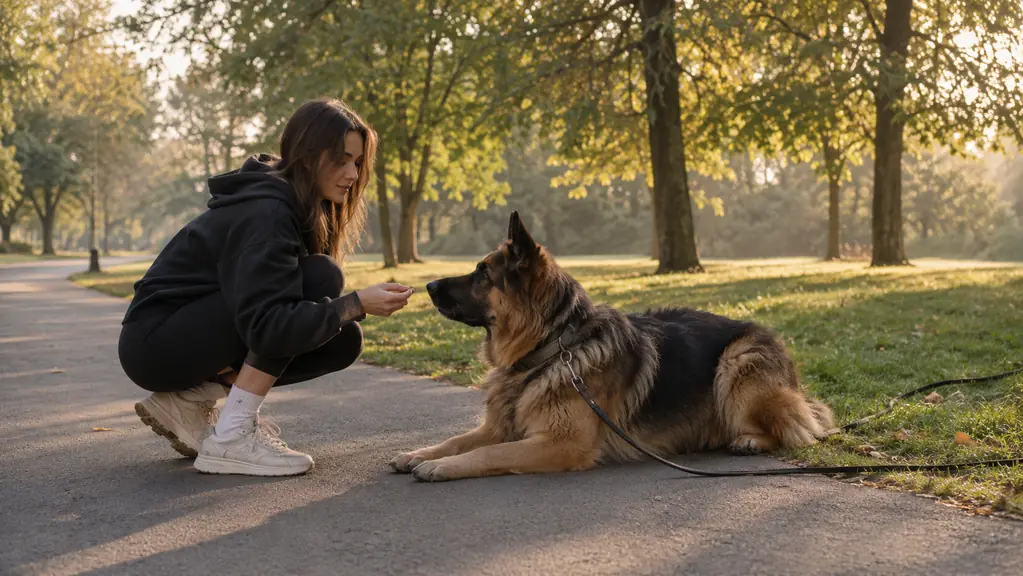
Behavior that works in a quiet kitchen does not automatically work on a sidewalk. It has to be built up one small step at a time, and each step gets paid for. My order with Biscuit was the back yard, then the front yard, then the driveway, then the sidewalk in front of the house, then the greenway. At every stage I expected less of him and paid him better.
Our back fence is only 4 feet tall and he can see the neighbor's dogs over the top of it, which made the yard a better training space than I expected. In the yard with nothing happening, a sit earns ordinary kibble. Out at the greenway with a squirrel and two joggers and a stroller coming at us, the same sit earns a piece of chicken. That is not bribery. That is paying the going rate for harder work, and any dog knows the difference.
If he fails three times in a row, I have asked for too much. The session is over, or I move back a step and finish where he can succeed. That one rule has saved me more frustration than anything else I have read about dog training. There is no benefit in grinding away at something your dog cannot currently do. Go back to the version that works, pay him well there, and try the harder one next week.
Step 5: Pay Less Often Without Losing the Behavior
A dog who is paid every single time will work every single time, and then one day you leave the pouch on the kitchen counter and he looks at you like you have broken a contract. Which, technically, you have. So you fade the payment on purpose, before he notices.
For the behaviors Biscuit knows cold, which around here means sit, down, and waiting at the door, I now pay maybe one in three, sometimes one in five. For anything new or anything hard, I still pay every time. The rule is simple enough to keep in my head: easy and old, pay sometimes. Hard or new, pay always. He never knows which one is coming, so he keeps offering the behavior, which is exactly what I want from him.
I still carry the pouch on every walk, even when it holds nothing but plain kibble. It costs me nothing to have it on my belt, and it means I never have to say no to a good decision he makes on his own. If he glances at me instead of at the mail truck as it goes by around one in the afternoon, I can pay that. If I am not carrying anything, I cannot, and the moment is already gone.
What Else Helps
The pouch carries the reward. It does not do the training by itself, and it is worth being plain about which tool does which job, because I mixed this up for a while and wasted a few months on it. For walks, the thing that actually changed Biscuit's pulling was the PetSafe Easy Walk harness I bought two years ago, sized for 50 to 100 pound dogs, with the leash on the front chest clip. The pouch just meant I could pay him for checking in while we walked, instead of only hauling on him.
For recall, the tool is a long line. I have a Hi Kiss 15-foot line, three quarter inch nylon with a swivel snap, and I only use it clipped to the back ring of a plain flat collar, never to the harness chest ring. Recall came together in the yard after about eight weeks. At the greenway it took about five months, and I still do not let him off the line anywhere unfenced. I wear gloves, because 15 feet of nylon moving fast will burn a hand.
For quiet time, the tool is a KONG Classic in size Large, stuffed with kibble and a peanut butter that has no xylitol in it, frozen overnight. He gets one when Ray and I leave the house and it lasts about 25 minutes frozen. It is enrichment, not a treatment for real separation anxiety, and I would say that to anyone who asked me. And for anything that is not about gear at all, I ask Dr. Sellers before I try it, which has saved me from two bad ideas and one expensive one.
You cannot reward a good decision you are not carrying a treat for
The eBasics treat pouch holds up to 3 cups, opens one-handed on a magnetic closure, and sits on an included belt or clips to a waistband so the reward arrives while the behavior is still happening. Rated 4.7 stars by more than 4,400 owners, and still on my belt after 22 months of daily use.
Amazon Check Today's Price on Amazon →