
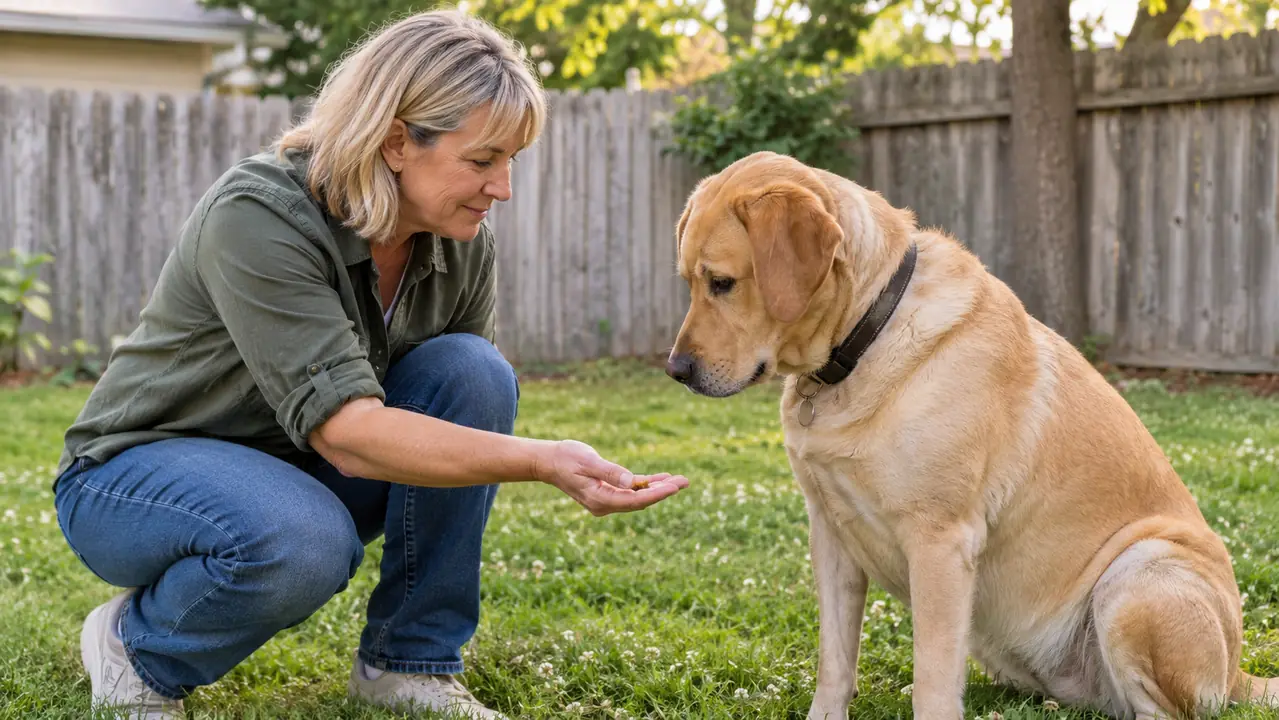
Nobody warns you that the hardest part of clicker training is your own timing. I bought the HoAoOo clicker about 20 months ago, mostly because it was small and I was tired of buying things that did not work. My dog Biscuit is a 4-year-old Lab mix, 62 pounds, adopted from a shelter at 14 months old. When he came home he pulled me down the sidewalk, jumped on anybody who rang the bell, and barked at the mail truck every afternoon around one. The little clicker did not fix any of that by itself.
What it did do was teach me to be precise, which sounds like a small thing until you try it. The first time I clicked, I clicked about three seconds after Biscuit had already finished doing the thing, and then I paid him for standing there looking confused. He was not confused. I was. Twenty months later I still keep one on my wrist for new skills, and I still use my voice, a plain spoken yes, for everything he already knows. This review is about the gap between what the listing promises and what actually happens in a back yard in Knoxville in February.
The Quick Verdict
Two clickers, a spring wrist coil that stretches to about 9.84 inches, and a press that marks a behavior the instant it happens. It will not train your dog. It will make your timing honest.
Amazon Check Today's Price →The smallest piece of training gear I still reach for after 20 months
Two clickers in the pack, one for your wrist and one for the kitchen drawer you will eventually need. Press to mark, then reward. That is the entire job, and it is enough.
Amazon Check Today's Price on Amazon →How I've Used It Around Biscuit
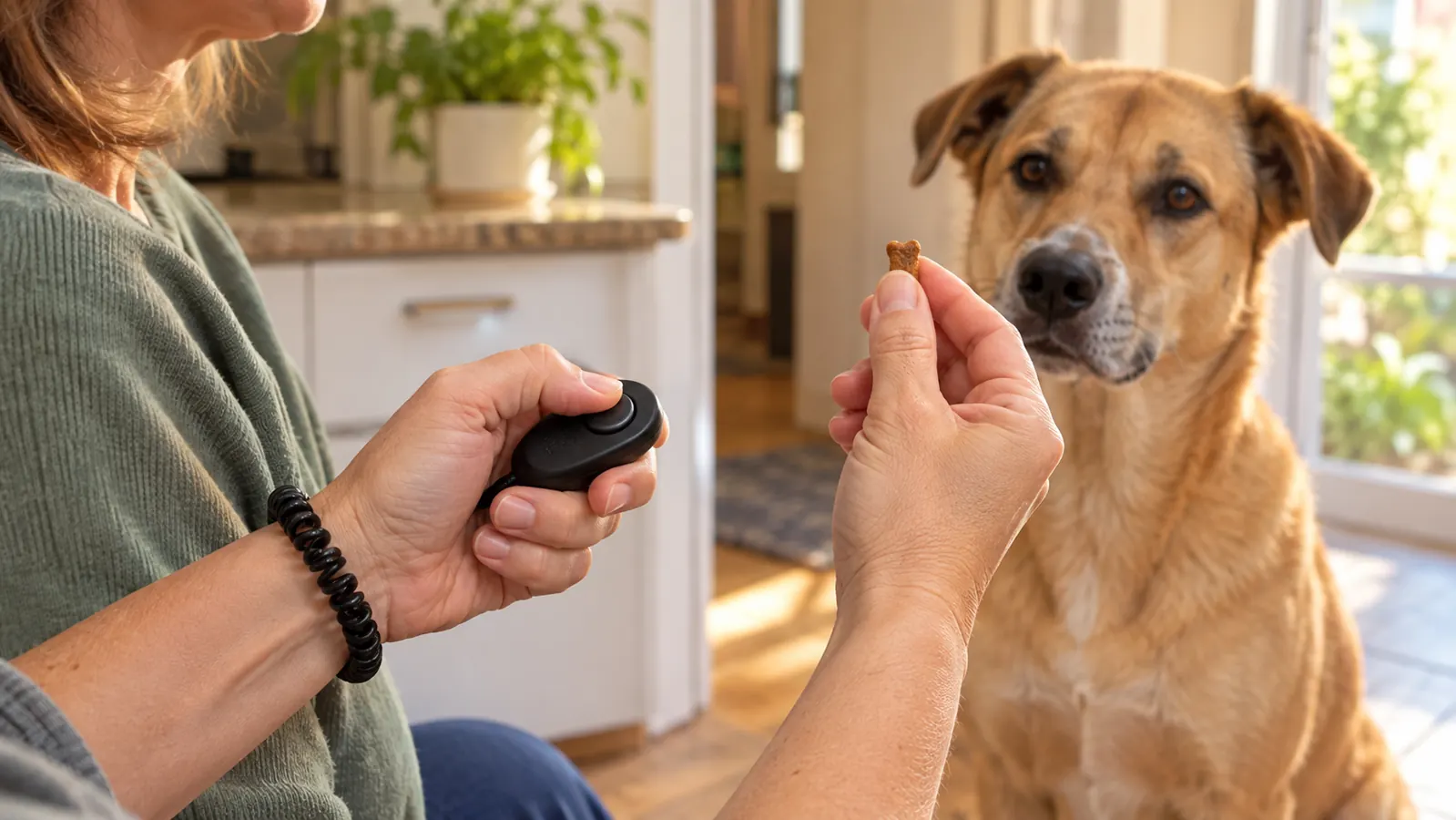
The HoAoOo pack comes with two clickers, one of each color, both on a spring wrist coil. I put one on my wrist and the other went into the kitchen drawer as a spare. The spring stretches from about 6.3 inches out to roughly 9.84 inches, which turned out to matter more than I expected. When you are reaching across a dog to deliver a treat, a fixed loop either slides off your hand or pulls tight against your wrist bone. The stretchy one just sits there.
The first session was in my kitchen on a Tuesday in February, with the back door shut so Biscuit could not wander off into the yard and find something more interesting than me. I had about a cup of cut up chicken in the treat pouch and no plan beyond charging the click. That means click, then treat, click, then treat, with no behavior required at all. Twelve repetitions, maybe ninety seconds, and he was already turning his head toward my hand when he heard the sound. The second session I waited for a sit. He offered one in about forty seconds, I clicked, and then I fumbled the treat and it rolled under the stove, which meant I spent the next minute on my hands and knees while he stared at the appliance. He still learned the sit. He also learned that the stove is worth checking every time he walks past it.
The listing says it is meant to mark behavior and that it works for dogs, cats, birds, and horses. That is accurate as far as it goes. What it does not say is that the sound is only half the job. The other half is the reward arriving within a second or two, and the reward arriving every single time in the early weeks. I used cut up string cheese and pieces of plain cooked chicken at first, and I kept them in the treat pouch on my belt so my hand was not digging around in a coat pocket while Biscuit wandered off.
I use the clicker for new behaviors only. Sit, down, come, and settle all run on a spoken yes at this point. The clicker comes out when I am teaching something Biscuit has never done, like touching his nose to my palm or holding a stay at the back door while I carry groceries through. Twenty months in, that split has not changed. New skill, clicker. Old skill, voice.
What a Clicker Actually Does, and What It Does Not
A clicker is a marker. It is not a remote control and it is not a correction. It says exactly one thing, which is: that thing you just did, right then, is what pays. The listing puts it plainly, press to mark the desired behavior, then reward for faster learning. Nothing about the device makes a dog obey. The device only removes the delay between the behavior and the information.
That delay is the whole problem with training by voice alone. If Biscuit sits and I say good boy a second and a half later, he has already moved on to sniffing the fence line, and now he is being paid for sniffing. The HoAoOo click is short and identical every time, so it lands inside the narrow window where he can still connect it to the sit.
Where people go wrong is expecting the clicker to carry the training. It cannot. If your dog has never been rewarded for a behavior, the clicker has nothing to mark. If your treats are dull, the click stops meaning much by day four. And if you are clicking from the couch while your dog is across the room, you are marking whatever he happened to be doing at that moment. I did all three of those things in my first month and I would like to say I stopped immediately. I did not.
What I Liked
- Two in the pack, so a lost or misplaced one is not a crisis
- Spring coil stretches to about 9.84 inches and stays on the wrist while you deliver a treat
- Light press that does not wear out your hand during a long session
- Item weight is 1.45 ounces, so the coil does not drag
- The listing covers dogs, cats, birds, and horses
- Wipes clean in seconds after a session in wet grass
Where It Falls Short
- The click is not loud enough to cut through a busy street or a strong wind
- The keyring attachment is small, and the spring can kink if a dog grabs at it
- Two clickers mean two slightly different sounds if you swap mid-session
- No real instructions beyond the listing text, so a total beginner is on their own
Biscuit connected the click with the treat in about three short sessions. It took me closer to three weeks to press it at the right moment.
Week One Is Mostly Your Fault
The first thing I would tell anyone is to practice without the dog in the room. Stand in the kitchen and click, then put a treat in your own hand. Ten times in a row, at the same speed. You are training your hand, not the animal, and in my house the hand was the slow part. By the time I got out to the yard I was clicking within half a second of the behavior, which is roughly where it needs to be for a dog to make the connection cleanly.
I spent the first three days charging the click before I asked for anything. Charging means the click predicts a treat and nothing else. Twenty clicks a day, a treat every single time, no behavior required. Ray watched me do this from the kitchen doorway and asked, reasonably, whether I had lost the plot. By day four Biscuit would swing his head around at the sound from the next room, which told me the marker had landed. Only then did I start waiting for a sit before I clicked. If you skip that step, the click is just a noise in a yard, and a noise does not pay.
The other mistake is charging the click in a busy moment, with the mail truck coming up the street or Ray in the room talking on the phone. Do it somewhere boring, so the only interesting thing in the room is you and the food. I did my charging reps on a Tuesday afternoon when the house was empty and the neighborhood was quiet, and I think that is a fair part of why it took hold as fast as it did.
The second thing is one behavior at a time. I tried to mark a sit and a quiet bark in the same session and Biscuit got a bargain on both. He offered me a sit, then a bark, then a sit with a small whine attached, and I paid for all of it because I could not tell which one I had clicked for. A dog will absolutely invent new moves to make the click happen. Eventually that is exactly what you want. In week one it is just noise.
The third thing is session length. Three to five minutes, maybe twice a day, then stop while he is still enjoying himself. My longest session ran about twelve minutes and it ended with Biscuit walking off to the far corner of the yard to sniff the fence. He was not tired. He was bored, and bored is the harder problem to fix.
The Wrist Spring and the Two-Pack
I expected the wrist coil to be a gimmick and it turned out to be the reason I kept using this clicker instead of the plain one I had before. If the clicker lives in your hand, you will set it down, and then you will be standing in the yard with a dog doing exactly the right thing and nothing to mark it with. On a stretchy coil it is already on your wrist when the moment comes. The spring on this one reaches about 9.84 inches, so it rides loose without slipping off.
The press itself is light enough that my hand does not cramp during a five minute session, which was not true of a metal clicker a neighbor lent me first. That one had a stiff tab that left a red dent in my thumb after about forty presses. This one takes almost no force at all. The whole HoAoOo clicker weighs 1.45 ounces, so the coil does not drag at your sleeve while you are crouched down at a dog's eye level. I wipe it with a damp cloth after a wet session in the yard and it has not gummed up once in 20 months. The spring has not stretched out either.
Having two matters more than I thought it would. The one on my wrist lives there during sessions and goes back in the drawer after. The spare has rescued a training session twice, once when the first one got knocked into wet grass and once when I simply could not remember where I had set it down. I have not lost a clicker in 20 months, which for me is close to a personal record.
The thing nobody mentions is that two clickers can sound slightly different from one another. Mine do not differ enough for Biscuit to notice, but I have talked to people whose pair did. If you are working on something delicate, use the same one for the whole session and keep the other strictly as a backup.
What Twenty Months Did Not Fix
The clicker did not fix the mail truck, and an honest review has to say so. What reduced the barking was a different product entirely, a large rubber toy stuffed with kibble and frozen overnight, given around one in the afternoon when the truck comes through. The clicker taught Biscuit to go to his bed when I ask, which helps on the days I catch it early, but it did not change how he feels about that truck.
It also did not fix the pulling. That took a front clip harness and about six weeks of consistent walks with the same rules every single time. Recall practice happened on a 15 foot long line at the greenway, not on a clicker, though the clicker did mark the exact moment he turned around and came back. If you are hoping a small plastic box will undo a habit your dog has rehearsed for years, it will not. What it will do is make every other piece of training stick faster than it did before.
The stay at the back door is the one I am proudest of and the one that took longest. I wanted Biscuit to hold a sit on the mat while I carried grocery bags in from the car. We started with one bag and a two second hold in October, and it was March before I could walk past him twice with both arms full. The clicker marked each correct hold and nothing else. There were plenty of days he broke early, and on those days I marked nothing, set the bags down on the step, and started over from the door. Twenty months in he holds it maybe ninety percent of the time. The other ten percent is usually a squirrel, and I have decided that is a fair trade.
Who This Is For
If you have a dog with no formal training and you are starting from zero, this is a sensible first buy, because it is small, simple, and it forces you to be precise whether you want to be or not. It also suits someone who has already tried voice training and come away feeling like the dog was ignoring them. Most of the time the dog is not ignoring you. He is being paid late.
It works for multi pet homes too, since the listing covers cats, birds, and horses along with dogs. And it suits people like me, who are not trainers and never will be, and who need a tool plain enough that they cannot overcomplicate it. I am a retired school bus driver with one dog and a fenced yard. That is the whole of my qualification, and this clicker was still worth the drawer space.
Who Should Skip It
If your dog is already trained and responds well to your voice, you do not need this. A spoken marker works fine once a behavior is fluent, and adding a second marker for known skills just gives you more to keep straight in your head on a cold morning.
If you are not willing to practice your own timing before you point it at your dog, skip it. A mistimed click is worse than no click, because it hands out information you never meant to give. And if the behavior you are dealing with involves fear or aggression toward people or other dogs, this is not the tool for that and I am not the person to advise you. I checked with Dr. Sellers before I started anything new with Biscuit, and I would check again.
It marks the moment. You still have to show up tomorrow.
Two clickers, a stretch coil that holds up to daily use, and 20 months without a failure in my house. If you are teaching one new skill this month, this is the piece of gear I would hand you first.
Amazon Check Today's Price on Amazon →